Why Your Flexibility Drops in the First Weeks of Autumn
Quick Answer: Muscle and connective tissue become less compliant at lower temperatures, so range of motion genuinely decreases in cold conditions - and a gym that is cooler than it was in summer produces measurably tighter positions in the same body. This is a warm-up problem rather than a lost-progress problem, and a longer, more progressive warm-up recovers most of it. Judge flexibility at the end of a session, not the start.
You were within a hand’s width of the splits at the end of August. The first October session, you are back where you were in June, and it is genuinely demoralising until you understand what happened - which is that the room dropped several degrees and your warm-up did not change.
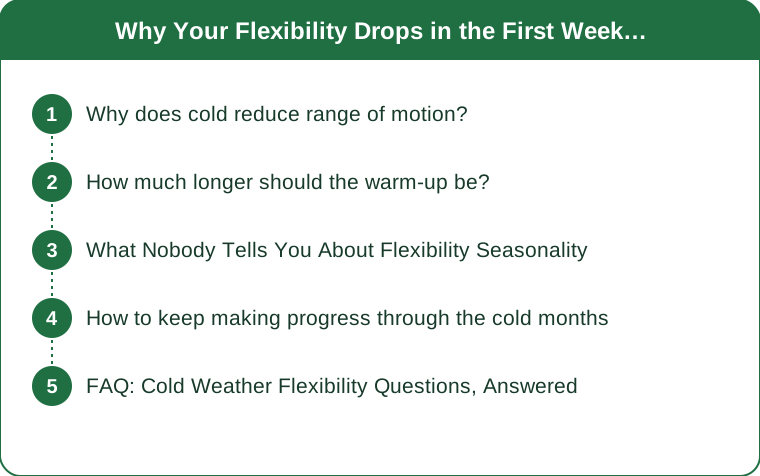
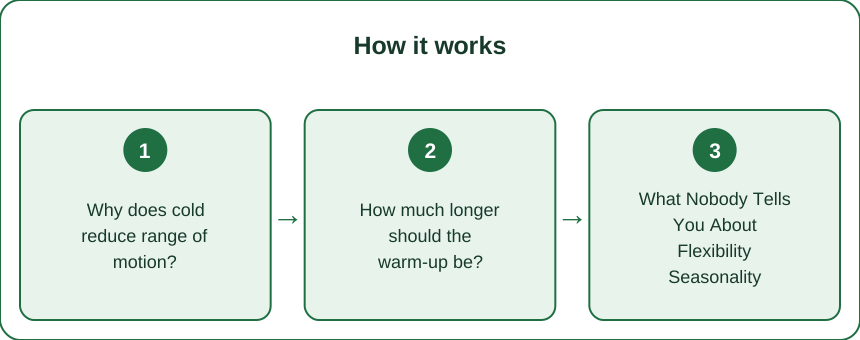
Why does cold reduce range of motion?
Because the tissue properties that allow stretching are temperature-dependent.
Muscle and connective tissue are viscoelastic, meaning their resistance to deformation depends on both how far and how fast you move them - and on their temperature. Warmer tissue deforms more readily under the same force.
Warming increases extensibility measurably. This is the mechanism behind warming up, and it is why a stretch at the end of a session goes further than the same stretch at the start.
Joint fluid viscosity also changes with temperature. Synovial fluid becomes less viscous as it warms, which is part of why joints feel stiff first thing and looser after movement.
Nervous system factors matter as much as tissue factors. A meaningful portion of what limits stretch is protective muscle activity - your nervous system restricting range at a point it perceives as risky. Cold, unfamiliar conditions, and tension all increase that protective response.
And gymnastics gyms are often cooler in autumn than the temperature suggests, because they are large-volume spaces with high ceilings that are expensive to heat, and floor-level air near mats and equipment can be cool even when the room reads acceptable.
The important implication: the tissue has not shortened and the training has not been lost. Range of motion measured cold has always been lower than range measured warm - the difference is that in summer, you arrived already warm.
How much longer should the warm-up be?
Substantially, and structured rather than just longer.
Aim for fifteen to twenty minutes in a cold gym, where ten might have sufficed in summer. The goal is a genuine rise in tissue temperature, which takes time.
Start with general movement, not stretching. Five to eight minutes of light cardiovascular work - jogging, skipping, easy conditioning - raises core and muscle temperature far more efficiently than stretching does. Stretching a cold muscle is both less effective and less comfortable than warming it first.
Then move to dynamic mobility. Controlled movements through increasing ranges - leg swings, hip circles, shoulder work, spinal movement. This prepares the tissue and the nervous system together.
Then move to activation and skill-specific preparation. Light versions of the shapes you will train, progressively deeper.
Save any long-hold static stretching for the end of the session, when tissue is at its warmest. There is also evidence that prolonged static stretching immediately before power-based skills can temporarily reduce force production, which matters for gymnastics specifically.
Keep layers on for longer than feels necessary. Warming up in leggings and a long-sleeve and removing layers as you heat up preserves the temperature you have built. Stripping down immediately and then standing around is counterproductive.
And re-warm after any long break in the session. Twenty minutes of queueing, coaching, or waiting means you have cooled, and returning to a deep skill straight from that is where injuries occur.

What Nobody Tells You About Flexibility Seasonality
Flexibility measured at the start of a session has always been lower than at the end - you just never noticed in summer. The seasonal drop is partly a change in what you are comparing. If your August benchmark was a warm end-of-session split and your October benchmark is a cold arrival, that is not a like-for-like comparison.
Real flexibility loss happens over weeks of not training it, not over a temperature change. If you trained consistently through the transition, your actual tissue capacity is very likely intact.
Time of day matters as well as season. People are generally stiffest shortly after waking and most mobile in the afternoon and early evening, following the same body temperature rhythm. A morning autumn session stacks two disadvantages at once.
Hydration affects tissue behaviour and people drink less in cold weather, which is worth knowing even though the effect is smaller than the temperature one.
Adults do gain flexibility - it is slower, not impossible. Adult gymnasts frequently make substantial mobility progress; the timescale is months rather than weeks, and consistency matters more than intensity.
Aggressive stretching in a cold gym is a genuine injury pattern. Forcing a deep position on cold tissue with a nervous system that is actively resisting is how people strain hamstrings and hip flexors. This is the practical reason the warm-up matters, beyond performance.
And progress is not linear even in ideal conditions. Flexibility fluctuates with sleep, stress, training load, menstrual cycle phase for some people, and recent training. A single bad session is weak evidence about anything.
Sharp pain during stretching, pain that persists afterwards, or a sudden loss of range should be assessed by a physiotherapist rather than trained through. This is general information, not medical advice.
How to keep making progress through the cold months
A structure that works when the environment is against you.
Do your dedicated flexibility work at the end of sessions, when you are warmest. This is the single most important scheduling change and it costs nothing.
Train mobility at home in the evening. A warm room at the end of the day, when body temperature is near its daily peak, is a better environment than a cold gym in the morning. Fifteen minutes, three or four times a week, in front of the television, is genuinely effective.
Use loaded and active methods, not only passive holds. Active work through the end of range - controlled articular movement, loaded stretching, and strength work at long muscle lengths - produces range you can actually use and tends to hold better than passive stretching alone.
Measure consistently or not at all. If you track progress, measure at the same point in the session under the same conditions. Comparing a warm August measurement with a cold October one produces a meaningless and discouraging number.
Accept a lower ceiling on cold days and train anyway. A session at ninety percent of your usual range is still a productive session. Chasing a summer number in an October gym is how people get hurt.
Warm up before you leave the house if the gym is cold. Ten minutes of movement at home means you arrive warm rather than starting from a cold journey.
And keep the long view. Flexibility gains in adults accumulate over months. A season where you maintain rather than progress is not a wasted season, particularly if the alternative was an injury from forcing cold tissue.
One practical note for gymnastics specifically: grip and hand condition also change in autumn. Drier air makes skin more prone to tearing, and hand care - filing calluses, moisturising away from training - matters more in the cold months.
FAQ: Cold Weather Flexibility Questions, Answered
Why am I less flexible in cold weather?
Muscle and connective tissue are viscoelastic, so they deform less readily at lower temperatures, and joint fluid is more viscous when cool. Your nervous system also restricts range more protectively in cold, unfamiliar conditions. The tissue has not shortened - it is simply stiffer at that temperature.
How long should I warm up in a cold gym?
Fifteen to twenty minutes, where ten might do in summer. Start with five to eight minutes of light cardiovascular work to genuinely raise tissue temperature, then dynamic mobility, then skill-specific preparation. Stretching a cold muscle first is both less effective and more uncomfortable.
Should I stretch before or after training?
Dynamic mobility before, longer static holds after. Tissue is warmest at the end of a session, so that is when deep flexibility work is most productive - and prolonged static stretching immediately before power-based skills can temporarily reduce force production.
Have I actually lost flexibility over the autumn?
Probably not, if you have kept training. Real loss takes weeks of not training the range. What usually happens is that your summer benchmark was a warm end-of-session measurement and your autumn one is a cold arrival, which is not a like-for-like comparison.
Can adults still improve flexibility?
Yes - it is slower than in children but far from impossible, and adult gymnasts routinely make substantial progress. The timescale is months rather than weeks, and consistent moderate work beats occasional aggressive stretching, which in cold conditions is also how strains happen.
TL;DR:
- Cold tissue is genuinely stiffer - viscoelastic properties and protective nervous system responses both change.
- A cold-gym warm-up should run fifteen to twenty minutes, starting with general movement, not stretching.
- Do dedicated flexibility work at the end of sessions, when you are warmest.
- Compare like with like: an August end-of-session split against an October arrival is not a fair measure.
- Forcing deep positions on cold tissue is a real injury pattern, not just an uncomfortable one.
The splits did not move. The room dropped four degrees and your warm-up stayed the same length.
Keep Reading
This article is for general informational and styling purposes only. Fit, sizing, and product availability may vary.