Why Adult Gymnasts Progress Faster on Strength Than on Skills
Quick Answer: Strength adapts through relatively fast physiological changes — neural efficiency in weeks, muscle in months. Skills require building an internal model of a movement your nervous system has never performed, which depends on accumulated correct repetitions rather than on effort or load. Adults typically have far more training capacity than skill exposure, so strength runs ahead.
Six months in, your compression is better, your straight-arm strength is genuinely improving, and you can hold a hollow body for twice as long as when you started.
The skill you actually came for looks exactly the same as it did in March.
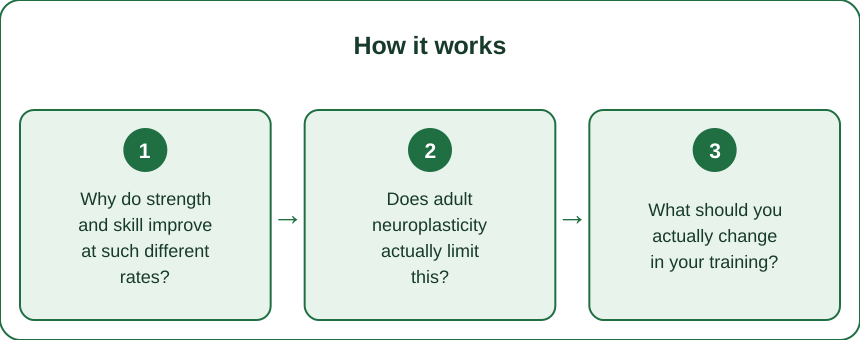
Why do strength and skill improve at such different rates?
Because they are different adaptations with different rate limits.
Strength gains in the first months are dominated by neural factors: better motor unit recruitment, improved rate coding, reduced antagonist co-contraction. These respond quickly to progressive loading — measurably within two to four weeks — and they generalise reasonably well. Add structural muscle adaptation over three to six months and you have a system that reliably improves when you push it.
Skill acquisition works on a different currency. You are building an internal model: a prediction of what force, timing, and body position produces a given outcome, refined by error. That model improves only through repetitions that give useful feedback, and the useful ones are those close enough to correct that your nervous system can detect the difference between what it intended and what happened.
The critical asymmetry: strength responds to effort, skills respond to correct repetitions. An adult can add effort easily — heavier, longer, more sets. Adding correct repetitions of a skill you cannot yet do is much harder, which is exactly why coaching progressions exist.
There is also a volume gap. A child in a competitive programme might attempt a skill 200 times a week for years. An adult attending two classes a week might manage 30. The strength work is comparable; the skill exposure is not remotely comparable.
Does adult neuroplasticity actually limit this?
Less than the internet suggests, and less than most adults assume when they get frustrated.
Adults learn motor skills perfectly well. What changes with age is not the capacity to learn but the conditions around it: less total practice time, more fear responses to inverted and airborne positions, more accumulated movement habits that interfere, and stiffer tissue that restricts some shapes outright.
That last one is worth separating out, because it is often mistaken for a skill problem. If you cannot achieve the shoulder flexion for a straight handstand line, no amount of handstand practice will produce a straight handstand. You are practising a shape your body cannot currently make, and every repetition reinforces the compensation. That is a mobility problem wearing a skill problem’s clothes.
Fear is the other big one and it is genuinely physiological, not a character flaw. Anticipatory tension changes muscle activation patterns, which changes the movement, which produces a worse outcome and confirms the fear. Adults have more to lose and better risk models, which is adaptive everywhere except a gymnastics floor.
The honest summary: adults progress on skills more slowly, mostly for reasons of exposure, fear, and mobility. Very little of it is the brain’s fault.
What should you actually change in your training?
Four adjustments that consistently move the needle for adult gymnasts stuck in this pattern.
Increase frequency, decrease intensity, for skills specifically. Ten minutes of handstand work five days a week beats an hour once a week by a wide margin. Motor learning consolidates between sessions, so more sessions means more consolidation events.
Practise in the range where you fail sometimes. Repetitions that are trivially easy generate no error signal and teach nothing. Repetitions that are wildly beyond you generate noise. The productive zone is roughly where you succeed 60 to 80 percent of the time.
Separate the mobility work and treat it as its own project. Shoulder flexion, thoracic extension, hip flexion in compression, ankle range. Test these once a month with actual measurements rather than assuming they are improving.
Video every session, briefly. Adults have unreliable internal feedback in inverted positions — what feels vertical is commonly 15 degrees off. Two clips a week collapses months of guessing into immediate correction.
And accept a longer timeline. Skills that a child acquires in a season commonly take an adult one to three years. That is not failure; it is the actual rate.
What nobody tells you about adult skill plateaus
A plateau is usually three separate things stuck together. Typically one mobility restriction, one strength gap at a specific joint angle, and one fear or timing issue. People attack it as a single problem, make no progress on any of the three, and conclude they are stuck.
Getting stronger can temporarily make a skill worse. New strength changes the force you produce for a given intent, and your internal model has to recalibrate. A week or two of the skill feeling clumsy after a strength block is a normal and encouraging sign.
The skill often arrives on a day that feels unremarkable. Motor learning is not linear and consolidates during rest. Plenty of people report the breakthrough happening on their first session back after a week off, which is disorienting if you believe progress comes from grinding.
Working with more advanced training partners can slow you down. You spend your rehearsal time on their progressions rather than yours. The third point surprises people, but skill practice is one of the few areas where training alone at your own level is genuinely better.
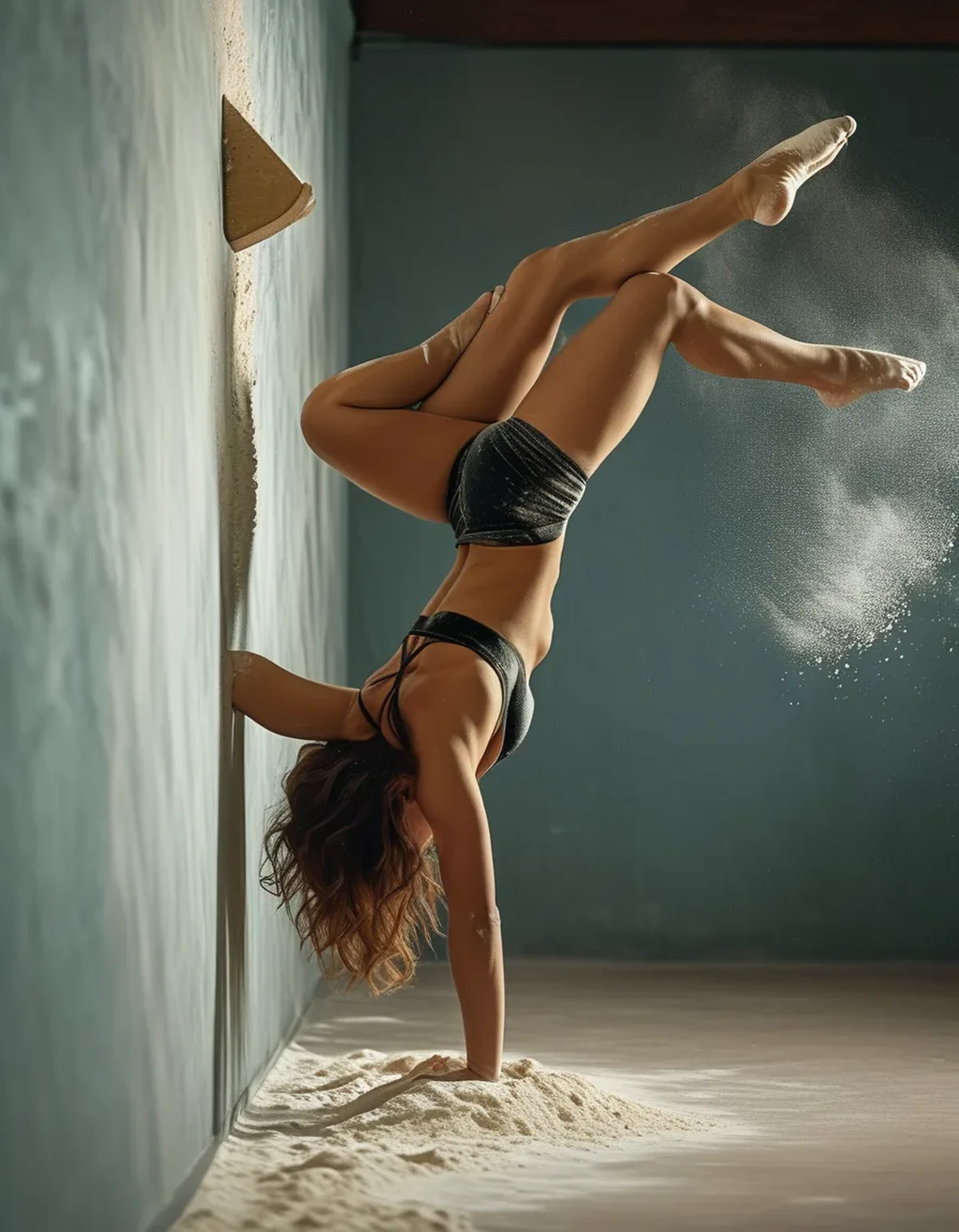
Most adults undertrain the entry and overtrain the shape. For a press handstand, hours go into the handstand and minutes into the compression and the transition — which is where the skill actually lives.
FAQ: Adult Gymnastics Progress Questions, Answered
How long should a skill take before I worry?
Give a well-structured progression six months of consistent, frequent practice before deciding it is not working. If there has been genuinely no change in any component — not the shape, not the hold time, not the consistency — the progression is probably wrong, not you.
Should I stop strength training and focus purely on skills?
No. Most adult skill work is limited by strength at specific joint angles, especially straight-arm positions that recreational training never touches. Keep the strength work; just rebalance how much time skills get.
Is it safe to learn inverted and airborne skills as an adult?
With coaching, progression, and appropriate matting, yes for most people. Get medical clearance first if you have any history of neck or spinal issues, uncontrolled blood pressure, or a condition affecting balance or vision. This is general information, not medical advice.
TL;DR:
- Strength responds to effort and adapts in weeks; skills need accumulated correct repetitions and adapt in months to years.
- Most adult plateaus are a mobility restriction, an angle-specific strength gap, and a fear response stacked together.
- Train skills often and briefly, in the range where you fail 20 to 40 percent of the time, with video.
- Feeling clumsy after a strength block is normal recalibration, not regression.
If the strength is climbing and the skill is not, your training is working — it is just working on the thing that was always going to move first.
Keep Reading
This article is for general informational and styling purposes only. Fit, sizing, and product availability may vary.