Why Your Body Remembers the Shape of a Skill But Not the Timing
Quick Answer: Positions are largely a matter of strength and joint familiarity, which decay slowly and return quickly. Timing depends on fine-grained motor sequencing and proprioceptive calibration, which decay faster and rebuild through repetition rather than through effort. This is why your handstand shape looks right in a photo but you cannot find the balance point. Rebuild timing with high-frequency, low-intensity repetitions - many short sets of easy versions - rather than by attacking the full skill harder.
You take three weeks off. You come back, hit the shape, and it looks correct in the mirror.
Then you try to actually do the skill and every single input arrives a beat late.

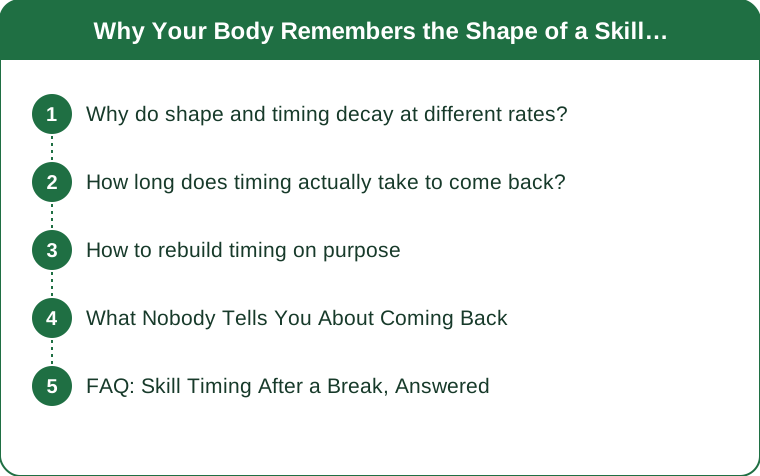
Why do shape and timing decay at different rates?
Shape is mostly strength and joint position sense, both of which are robust. Strength declines slowly over a few weeks, and the feeling of a familiar joint position persists considerably longer than that.
Timing is a sequencing problem. A skill is not one instruction - it is a chain of small corrections firing in a specific order at specific intervals. That chain is a finer, more perishable structure than the gross position it produces.
Proprioceptive calibration drifts with disuse. Your sense of where you are in space is continuously updated by practice, and without input it becomes less precise. You feel this as being slightly late rather than being wrong.
Confidence changes the timing directly. Hesitation on an inversion adds a genuine fraction of a second, and in a skill built on rhythm that fraction is the whole difference. This is why the first sessions back feel mechanically fine and rhythmically hopeless.
The nervous system also runs a bit more cautiously after a layoff, damping the fast corrections it will happily make when the pattern is familiar and recent.
And you are comparing against your best, not your average. The version of the skill in your head is the good day from before the break, which makes an ordinary session back feel like a bigger loss than it is.
How long does timing actually take to come back?
Far less time than it took to build. The pattern is not gone - it is uncalibrated. Most people recover skill timing after a short break within one to three sessions of focused, high-repetition work.
The recovery is not linear and that is normal. It typically comes back in a step rather than a slope: two frustrating sessions and then one where it simply works. Expecting the step prevents a lot of unnecessary discouragement.
Frequency beats intensity here, decisively. Three short sessions in a week rebuild timing faster than one long session, because calibration responds to number of exposures rather than total volume.
Longer breaks cost more but not proportionally. Three months off is not four times worse than three weeks - the pattern persists, and re-entry is usually faster than newcomers expect.
Strength loss is the part that genuinely takes time, and it is worth separating from timing in your head. If a skill is not returning after several sessions, the limiter is often conditioning rather than rhythm.
And seasonal changes contribute more than people credit. Cooler gyms in the first weeks of autumn mean longer warm-ups are needed, and a cold body is a slow body - some of what reads as lost timing in September is just an under-warmed one.

How to rebuild timing on purpose
Regress the skill until the rhythm is available again, then work forward. If a full handstand press is late, do the shape against a wall and the entry from a lower position separately, at a tempo you can actually control.
Do many short sets. Six sets of three with full recovery rebuilds calibration better than two sets of ten with fatigue in the way. Tired repetitions teach tired timing.
Practise the entry more than the skill. The first quarter of most skills sets the timing for everything after it, and it is also the safest part to repeat endlessly.
Use an external rhythm cue. Counting aloud, a metronome, or a coach clapping the beat gives your nervous system an anchor while its internal one recalibrates. This feels remedial and works remarkably well.
Film one set per session, not every set. Video resolves the shape-versus-timing question immediately - you will usually see a correct position arriving late rather than an incorrect position.
Extend your warm-up in the first weeks back, and particularly now that studio temperatures are dropping. Ten minutes more of general movement before skill work buys back a meaningful amount of speed.
And accept a lower ceiling for two sessions. The most common way people extend a comeback is by attacking the full skill at full intensity on day one, getting a scare, and adding hesitation on top of the timing problem they already had.
What Nobody Tells You About Coming Back
The skills that come back last are not the hardest ones. They are the ones with the tightest timing windows. A strength-dominant hold returns quickly; a skill with a narrow rhythmic window takes longer regardless of difficulty.
Your shape may actually be better after a break. Time off resolves accumulated compensations and minor irritations, and a lot of people find their position cleaner and their timing worse in the same session.
Fear is a timing variable, not a character trait. It manifests as a measurable delay in commitment, and it responds to graded exposure exactly as any other physical parameter does.
Coaches can see the difference immediately. If you are unsure whether you have lost the pattern or the calibration, ask - it is one of the easiest things for an experienced eye to distinguish, and it changes what you should do next.
Cross-training preserves timing poorly but preserves the strength underneath it well, which is a good deal. Keeping general conditioning through a break means you return with only the calibration to rebuild.
And the frustration peaks in session two. Session one you expect to be rusty. Session two you expect to be back, and you are not - which is exactly when most people train too hard and set themselves back another week.
FAQ: Skill Timing After a Break, Answered
Why does my shape look right but the skill still fails?
Position depends on strength and joint familiarity, which persist. Timing depends on fine motor sequencing and proprioceptive calibration, which drift faster with disuse.
How many sessions until the rhythm comes back?
After a short break, typically one to three focused sessions. It usually returns as a step rather than a gradual slope, so a frustrating second session is normal rather than a warning sign.
Should I train the full skill or regress it?
Regress it. Train a version whose tempo you can control, in many short sets, and build forward. Attacking the full skill adds hesitation on top of a calibration problem.
Does more volume speed it up?
No - more frequency does. Three short sessions beat one long one, because calibration responds to number of quality exposures rather than to total work.
Why does it feel worse in a cold gym?
A cold body moves and corrects more slowly. In the first cool weeks of the season, add ten minutes to your general warm-up before touching skill work.
When is it strength rather than timing?
If several focused sessions produce no change in rhythm, the limiter is usually conditioning. Timing responds fast; strength does not, and they need different plans.
This is general training information, not medical advice - if a skill produces pain rather than difficulty, see a professional.
TL;DR:
- Shape survives a break because it rests on strength and joint familiarity; timing decays faster because it is fine motor sequencing.
- Timing usually returns in one to three focused sessions, and it comes back as a step rather than a slope.
- Frequency beats intensity - many short sets with full recovery, not long fatigued ones.
- Regress the skill, practise the entry, use an external rhythm cue, and film one set per session.
- Extend warm-ups in cooler months; a cold body reads as lost timing when it is only an under-warmed one.
Session two is where people train too hard. Expect it and hold back.
Keep Reading
This article is for general informational and styling purposes only. Fit, sizing, and product availability may vary.