Why the Skill You Just Learned Disappears the Following Week
Quick Answer: A skill performed well once has been acquired but not consolidated. Performance during a session reflects short-term learning, which decays quickly; durable retention requires repeated retrieval across separate days and sleep between attempts. Losing a skill after a week is not regression — it is the normal gap between doing something and owning it.
Once a week is the hardest possible schedule for learning motor skills, and it is the one most adults are on.
This is general information, not medical advice.

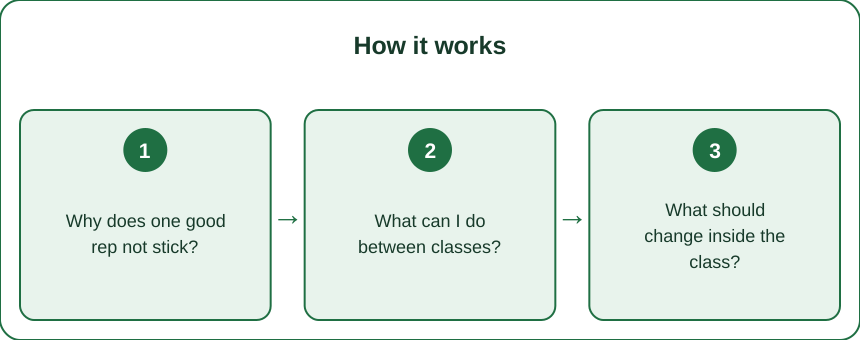
Why does one good rep not stick?
Performance and learning are different things. How well you do something during a practice session is a poor predictor of how well you will do it later. This distinction is one of the most established findings in motor learning research.
Conditions that boost performance often reduce retention. Heavy spotting, immediate feedback after every attempt, and repeating the same drill in a block all make the session look good and the following week look bad.
Consolidation happens between sessions. The skill is stabilised in the hours and days afterwards, particularly during sleep. A single exposure gives that process very little to work with.
Seven days is a long gap. Most of the decay after a single acquisition session happens within the first few days, so a weekly class means arriving at the bottom of the curve every time.
What can I do between classes?
Practise retrieval, not repetition. Trying to recall and perform the shape cold — even at low intensity, even on the floor at home — does far more for retention than watching video of it.
Short and frequent beats long and rare. Ten minutes on three separate days outperforms thirty minutes in one sitting for motor retention. This is one of the most reliably replicated findings in the field.
Work the entry, not the skill. Most home practice should be the position you enter from and the shape you hold, both of which are safe to rehearse without equipment.
Do not rehearse anything you cannot do safely alone. Inversions, releases, and anything requiring a spot stay in the gym. Shapes, holds, conditioning, and entries are the home-appropriate parts.
Mental rehearsal genuinely helps. Visualising the skill in first person, at real speed, activates overlapping motor pathways and measurably supports retention. It is not a substitute for practice, but it is not nothing.
What should change inside the class?
Ask for less feedback, later. Feedback after every attempt creates dependence on it. Feedback after every third attempt, delayed by a few seconds, produces worse sessions and better retention.
Interleave rather than block. Rotating between two or three skills is harder in the moment and retains better than twenty repetitions of one thing.
Vary the conditions slightly. Different surfaces, different entry speeds, and different starting positions all build a more robust version of the skill than perfect repetition of one variant.
Ask for the spot to be reduced early. A skill that only exists with hands on it has not been learned yet, and knowing that sooner is useful.
Accept worse sessions. If the class feels harder and the retention improves, that is the trade working as intended.

What Nobody Tells You About Adult Skill Acquisition
Adults acquire more slowly and retain roughly as well. The commonly repeated idea that adults simply cannot learn these skills is not supported; the acquisition rate differs more than the retention does.
Fear is a motor problem, not just a psychological one. Apprehension changes muscle activation timing and produces exactly the hesitant, half-committed attempt that makes the skill fail, which then confirms the fear.
Strength gains show up before skill gains and can mask them. Conditioning improvements over a term are often larger than they feel, because the skill work is what you notice.
Progress in adults is genuinely non-linear. Plateaus of several weeks followed by sudden jumps are the normal pattern, not a sign that something is wrong.
And the one nobody says out loud: once a week, with no home practice, is close to the minimum viable dose for learning anything new. Two short home sessions a week changes the trajectory more than any change to the class itself.
What does a realistic week look like?
One class, plus two ten-minute home sessions. That is the minimum structure that turns weekly classes into actual progress, and it costs twenty minutes a week.
Home session one, early in the week: the shapes from last class — hollow, arch, straight-body holds — plus the entry position of whatever skill you are working on. Cold, from memory, no warm-up rehearsal.
Home session two, the day before class: the same material again, briefly. This is the retrieval that carries the skill into the session rather than rebuilding it there.
Conditioning fits anywhere. Wrist preparation, hollow body work and grip strength are safe alone and are the limiting factor for most adults more often than the skill itself.
Keep a two-line log. What you attempted and what it felt like. Adults dramatically underestimate their own progress across a term, and a log is the correction for that.
FAQ: Skill Retention Questions, Answered
How long before a skill is genuinely mine?
A reasonable working benchmark is being able to perform it cold, without a warm-up rehearsal, on three separate days. Until then it is still fragile.
Does a two-week break undo everything?
No. Recognition and coordination return much faster than they were built. Expect one rusty session rather than starting over.
Should I film every attempt?
Film occasionally, not constantly. Reviewing video is useful for correction and unhelpful during acquisition, because it shifts attention outward when you should be building internal feel.
TL;DR:
- Performing a skill once means acquisition, not consolidation — the two are different.
- Most decay happens in the first few days, so a weekly class lands at the bottom of the curve.
- Ten minutes on three days beats thirty minutes once, for retention.
- Practise entries, shapes and holds at home; leave anything needing a spot in the gym.
- Ask for less frequent feedback and interleaved practice — worse sessions, better retention.
You did not lose it. You never finished building it.
Keep Reading
This article is for general informational and styling purposes only. Fit, sizing, and product availability may vary.