When It's Your Grip, Not Your Skill, That's Stopping Adult Gymnastics Progress
Quick Answer: In adult gymnastics, grip endurance almost always lags behind pulling strength, because forearm connective tissue adapts more slowly than muscle and adults arrive with decades of low grip demand. The fix is training grip separately, two or three short sessions a week — dead hangs, timed holds, and controlled swings — not more bar skills. Expect 8 to 12 weeks for meaningful change, and use grips or straps to keep skill practice going in the meantime rather than stopping.
You can do the pull. You can hold the shape. Your coach says the technique is there.
And then, four seconds into the hang, your fingers open and the bar leaves your hands whether you agreed to it or not. That’s not a skill problem, and treating it like one is why it hasn’t improved.

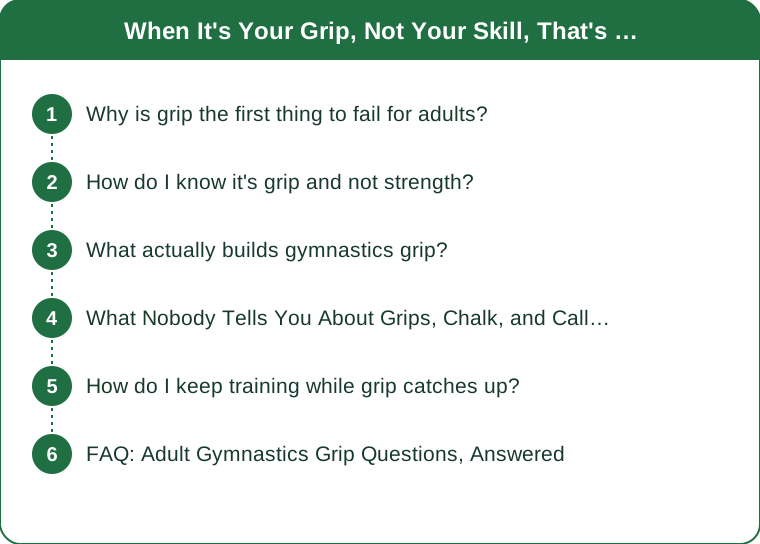
Why is grip the first thing to fail for adults?
Because grip endurance is the most training-specific quality in the body, and adult life provides almost no stimulus for it.
A child who does gymnastics has been hanging from things for years. Playground bars, tree branches, monkey bars — thousands of accumulated minutes of hanging before any formal training starts. That’s a decade of grip conditioning most adults simply do not have.
Muscle strength adapts in weeks. Tendon and ligament adapt in months. Your forearm muscles will get strong enough to hold your weight relatively quickly. The connective tissue in your fingers and wrists lags behind by a considerable margin, and that lag is what you feel at second four.
Body weight matters and nobody wants to say it. An adult hanging is loading their grip with far more mass than a 60-pound child. Same skill, entirely different demand.
Desk work actively works against you. Hours of typing keeps the forearm flexors in a shortened, low-load position, which builds neither endurance nor tissue tolerance.
The good news: grip responds fast to direct training. It’s one of the qualities where three focused sessions a week produces visible change within a month.
How do I know it’s grip and not strength?
Run this test: do the same movement with straps or grips. If it suddenly works, it’s your hands.
Test one — the strapped comparison. Attach lifting straps and repeat the hang or the pull. If you get double the time or double the reps, your pulling musculature was never the limitation.
Test two — the dead hang clock. A passive dead hang from a bar. Under 20 seconds is a clear grip deficit. 30 to 45 seconds is functional. 60+ seconds means grip is not your limiting factor for most beginner and intermediate bar work.
Test three — where the burn is. Failure in the forearms and fingers is grip. Failure in the lats, biceps, or upper back is strength. People routinely misreport this, so pay attention deliberately for one set.
Test four — the second-attempt drop-off. If your first set is 25 seconds and your second is 9, that’s an endurance and recovery problem in the forearm, not a strength ceiling.
A note on what isn’t grip: if your hands are fine but you’re sliding off the bar, that’s chalk, humidity, or bar surface — an entirely different fix.
What actually builds gymnastics grip?
Dead hangs, active hangs, and timed support holds. In that order, three times a week, ten minutes total.
Dead hangs — passive, shoulders relaxed. Start with 3 sets of 15 to 20 seconds, rest 90 seconds. Add 5 seconds per set each week. This builds tissue tolerance more than muscle.
Active hangs — shoulders pulled down and back. Same volume, considerably harder. These build the shoulder-grip connection that bar skills actually require, and they’re what transfers to swinging.
Support holds on parallel bars or rings. 3 sets of 15 to 30 seconds. This trains the wrist in extension under load, which is a completely separate quality from hanging and the one most adults neglect entirely.
Farmer’s carries. 3 sets of 40 meters with the heaviest dumbbells you can hold. Unglamorous and extremely effective — this is the highest return-per-minute grip exercise there is.
Towel hangs, once a week maximum. Hang from a towel draped over the bar. Brutal, effective, and easy to overdo — it loads the fingers in a way that needs real recovery.
What to avoid: daily grip work. Forearm tissue needs 48 hours. Training grip six days a week is the fastest route to medial elbow pain, which will cost you more weeks than the training gained.

What Nobody Tells You About Grips, Chalk, and Calluses
Using grips isn’t cheating and delaying them isn’t virtuous — but starting in them too early does create a specific gap.
Leather grips shift load from your fingers to the dowel and the wrist strap, which is exactly what they’re designed to do. They let you keep practicing skills while your bare grip catches up. Use them for skill work; do your conditioning without them.
The gap they create: if all your bar time is in grips, your bare hands never adapt, and you’ll be dependent on equipment that has to be with you. A reasonable split is grips for skill sessions, bare hands for hangs and conditioning.
Chalk is not optional and most adults use it wrong. A thin, even layer on the palm and fingers. A thick cakey coating actually reduces friction and creates a layer that slides against itself.
Calluses need managing, not admiring. A raised callus catches on the bar and tears at exactly the wrong moment. File them flat weekly with a pumice stone or callus shaver after a shower — the goal is thick, smooth skin, not a ridge.
The rip everyone gets eventually: keep it clean, keep it covered during the day, leave it open to air at night, and stay off the bar for three to five days. Ripping the same spot repeatedly because you came back early is how a two-week problem becomes a two-month one.
And the thing that surprises people most: grip strength often improves faster than any other quality in adult gymnastics. Athletes who feel hopelessly behind at week one are frequently the ones with the biggest measurable jump by week ten.
How do I keep training while grip catches up?
Restructure the session order rather than reducing the session.
Put skill work first, when your hands are fresh. Grip-limited athletes who do conditioning first arrive at the skill portion with nothing left. Skills, then strength, then grip conditioning at the end.
Use straps or grips for the volume work and bare hands for the quality work. You get the practice reps without the hands being the ceiling on every single one.
Substitute floor and beam work on grip-recovery days. There is an entire sport that doesn’t require hanging — conditioning, flexibility, handstand work, and beam basics all progress fine on a day your forearms need off.
Break bar sets into shorter, more frequent pieces. Six sets of 10 seconds accumulates more quality hanging time than two sets of 25 when grip is the limiter, and it’s far kinder to the tissue.
Track one number weekly: max dead hang, once a week, same time in the session. It’s the single clearest progress metric available in adult gymnastics, and watching it move from 18 seconds to 45 does more for motivation than any amount of encouragement.
FAQ: Adult Gymnastics Grip Questions, Answered
How long until my grip stops being the limiting factor?
With three dedicated sessions a week, most adults see a doubling of dead hang time in 8 to 12 weeks. Full tissue adaptation for higher-load skills takes longer — closer to six months — but the frustrating phase ends much sooner than that.
Are grip trainers and hand grippers useful?
They train crushing grip, which is a different quality from the supporting grip hanging requires. They’re not harmful and they’re not the priority. Hangs and carries transfer far better.
My forearms hurt near the elbow. Should I push through?
No. Pain on the inside of the elbow is typically an early overuse signal in the forearm flexor tendons. Reduce grip volume by half, keep the movement going with lighter work, and if it persists past two weeks, get it looked at.
Should I train grip on the same day as bar skills?
Yes, at the end of the session. Doing grip conditioning before skill work compromises the skill practice, which is the more valuable part.
This is general information, not medical advice.
TL;DR: If your hands quit before your back does, you have a training gap, not a talent gap.
- Adults arrive without a childhood of hanging. Connective tissue is the lag, not muscle.
- Diagnose it with straps — if the strapped version doubles your output, grip was the ceiling all along.
- Dead hang under 20 seconds is a clear deficit; 45+ means grip isn’t what’s stopping you.
- Hangs, active hangs, support holds, and farmer’s carries, three times a week, ten minutes.
- Never train grip on consecutive days. Forearm tissue needs 48 hours, and medial elbow pain is the price of ignoring that.
- Grips for skill volume, bare hands for conditioning — that split avoids both the ceiling and the dependency.
Time one dead hang this week and write the number down. In eight weeks, that number is the clearest evidence of progress you’ll have.
Keep Reading
This article is for general informational and styling purposes only. Fit, sizing, and product availability may vary.