Adult Handstand Fear: Wall Progressions That Actually Work
Quick Answer: Handstand fear is not a courage problem - it is a missing-exit problem. The brain refuses positions it cannot safely leave, so the progression that works trains the escape first: learn the cartwheel bail-out at low stakes, then build inversion tolerance with chest-to-wall walk-ups (not kick-ups), add wall walks and shoulder taps, and only then practice kicking up with the exit you already own. Prep the wrists every session, train in short daily doses, and expect months - adults learn handstands reliably; they just learn them in order.
Every adult gymnastics class contains someone hovering at the wall, mid-kick, pulling back at the last second - sometimes for weeks. The instinct being fought is not weakness; it is a perfectly sensible refusal to fall backward into the unknown. The fix is not more courage. It is removing the unknown.

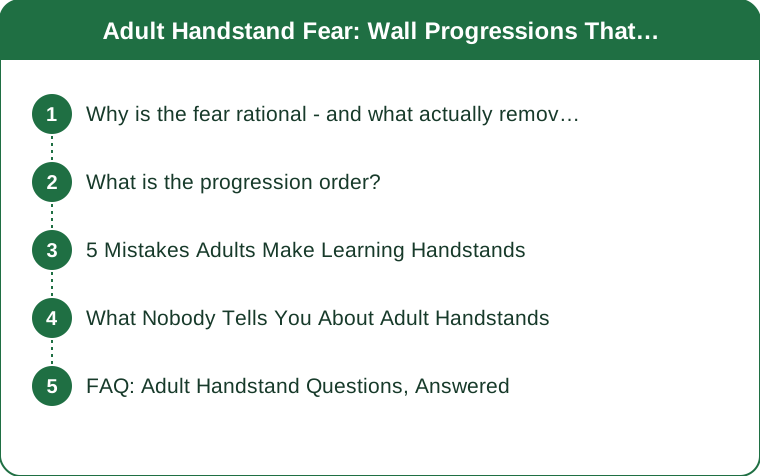
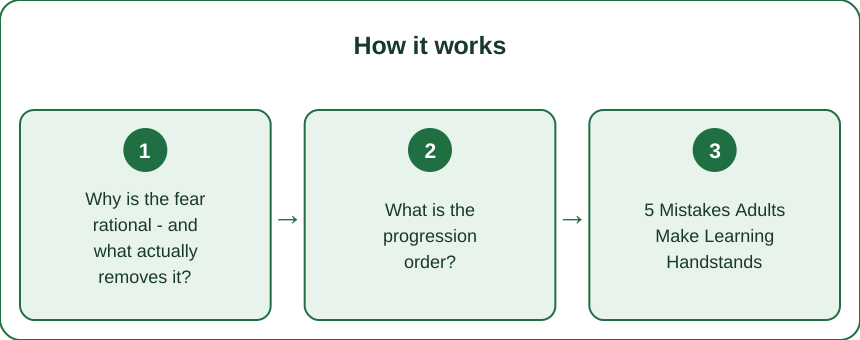
Why is the fear rational - and what actually removes it?
Because upside down is genuinely novel territory, and the nervous system treats unproven positions as threats.
The brain demands an exit before it grants a position. In any skill with a falling risk, hesitation tracks one question: what happens if this goes wrong? While the answer is unknown, the body sabotages every attempt - under-kicking, bailing early, bending arms. This is protective and correct. The entire strategy of a good progression is answering the question before asking for the skill.
The answer is the cartwheel bail-out. When a handstand overbalances, the trained exit is simple: turn the hips, step one hand slightly, and let the legs come down to the side - a controlled quarter-cartwheel landing on one foot, then the other. It works from any height of overbalance, requires no flexibility, and once owned, converts falling over from catastrophe to footstep.
Train the exit at zero stakes first. From standing, practice slow lunge-entry cartwheel-outs at knee height - hands down, hips barely up, step around and out. Dozens of easy reps. Then slightly higher. The drill is boring, which is exactly the point: boring is what safety feels like to the nervous system.
Under-kicking has a partner crime: over-gripping the floor far from the wall. Both fade as the exit gets proven - which is why bail-out practice improves the handstand faster than handstand practice does, in the early weeks.
Two honest notes: a soft mat beside the practice space helps confidence more than under the hands (squishy surfaces make balancing harder), and anyone with wrist, shoulder, or blood-pressure concerns should clear inversion training with a professional first. General information, not medical advice.
What is the progression order?
Seven rungs, each earned before the next - most adults spend two to six weeks per rung, and the ladder is the shortcut.
Rung zero: wrists, every session. Hands take the whole body’s weight in extension - a position modern wrists rarely visit. Two minutes of prep: wrist circles, palm-down rocking on all fours, fingertip presses, and a gradual loading of weight over the hands. Skipping this is how week three becomes a rest month.
Rung one: elevated pike holds. Feet on a box or couch, hips stacked over shoulders, arms straight - the body learns vertical loading through the arms with the head barely below the heart. Build to three comfortable 20-second holds.
Rung two: chest-to-wall walk-ups. Feet walk up the wall from a push-up position while hands walk toward it, chest facing the wall - stopping wherever comfortable. This is the gold-standard entry because it is incremental: no kick, no commitment moment, complete control of the angle. Walk down the same way. Progress by getting hands closer to the wall over weeks.
Rung three: higher walk-ups plus holds. Hands within a foot of the wall, body nearly vertical, holding 10 to 20 seconds while pressing tall through the shoulders. Here the real handstand shape gets built: ribs in, glutes on, toes reaching.
Rung four: shoulder taps and weight shifts at a comfortable angle. Small deliberate shifts side to side, then brief taps - teaching the hands to steer.
Rung five: back-to-wall kick-ups, exit ready. Now - and only now - practice the kick, with the wall catching overshoot and the cartwheel bail-out (already owned) handling everything else. The kick calibrates fast when fear is not editing it.
Rung six: freestanding attempts, wall nearby. Short holds, generous ambitions, daily practice. The wall never becomes shameful - professionals train on it forever.

5 Mistakes Adults Make Learning Handstands
1. Starting with the kick-up. The kick is the hardest confidence moment in the whole skill - a blind commitment executed before any inversion tolerance exists. Starting there is starting at the boss level, and the weeks of hovering half-kicks it produces teach hesitation as a habit. Chest-to-wall first; the kick comes fifth, not first.
2. The banana back. Overarching - ribs flared, belly sagging toward the wall - feels stable and photographs terribly, because balance is coming from the spine instead of the shoulders. The cues that fix it: press the floor away hard, ribs down, squeeze glutes, reach the toes to the ceiling. A hollow, tight line is both safer and dramatically easier to hold.
3. Looking at the wall instead of the floor. Head position steers everything upside down. Tucking the chin fully (looking at the wall behind you) or craning hard both bend the line; the working gaze is at the floor between and slightly ahead of the hands, head near-neutral.
4. Big weekly sessions instead of small daily ones. Inversion tolerance and balance reflexes build on frequency - ten focused minutes most days beats an hour on Saturday by a wide margin, and keeps wrists inside their budget. Handstands are a practice, not a workout.
5. Practicing scared and tired. The last attempts of a fatigued session are where form dissolves and scary moments happen - which then bill the next session’s confidence. End on a good rep while fresh-ish, every time. Fear management is progress management.
Bonus: never filming. A ten-second phone video against the wall shows the line you cannot feel - the banana you would swear is straight, the bent elbow you never noticed. The camera is the cheapest coach in gymnastics.
What Nobody Tells You About Adult Handstands
Clothing becomes surprisingly load-bearing upside down. A loose shirt obeys gravity - straight over your face mid-hold, which is disorienting exactly when orientation matters most. The uniform that works: a fitted tank or tee (or one tucked hard), and high-waisted leggings that stay planted through inversion - the same stay-put logic as yoga wear, applied at 180 degrees. Bare feet or thin grippy socks beat cushioned trainers for feeling the wall.
Wrists set the session length, not effort. Adult wrists adapt slower than adult enthusiasm - aching wrists mid-week is the signal to shrink doses, not push through. Five-minute blocks, fists-or-parallettes variations if extension stays cranky, and the two-minute prep ritual forever. Most adult handstand injuries are wrist overuse wearing an impatience costume.
Progress is nonlinear and the milestones are weird. The journey is not a smooth curve toward sixty seconds - it is plateaus punctuated by sudden unlocks: the first controlled walk-down, the first accidental two-second float off the wall, the first bail-out executed without thinking (the real graduation). Celebrate the strange milestones; they are the actual skill assembling.
Age is a smaller variable than consistency. Adults in their forties and fifties learn freestanding handstands regularly - with better practice discipline than most twenty-year-olds, which largely offsets slower adaptation. The realistic timeline for a first brief freestanding hold via this progression is months of near-daily short practice - and the wall version arrives far sooner and feels almost as triumphant.
And the fear never fully vanishes - it converts. What was dread becomes respect: a background awareness that keeps practice sharp. The gymnasts who look fearless are not missing the signal; they have answered it so many times it whispers instead of shouting. That conversion, more than the hold itself, is what adults come back to class for.
FAQ: Adult Handstand Questions, Answered
How long does it take an adult to learn a handstand?
With short near-daily practice through a wall progression: weeks to reach comfortable chest-to-wall holds, a few months for controlled kick-ups, and commonly six months to a year-plus for a reliable freestanding hold. The spread is wide because frequency dominates - ten minutes most days beats an hour weekly by months of calendar time.
I am scared of falling on my back - how do I get past it?
By making that outcome mechanically impossible to reach unprepared: train the cartwheel bail-out at low height until it is boring, use chest-to-wall entries (which cannot dump you backward), and only add kick-ups once the exit is automatic. Fear tracks unanswered what-ifs; the progression answers them in order, and the fear deflates on schedule.
My wrists hurt during handstand practice - what should I change?
Shrink the doses (multiple five-minute blocks beat one long session), never skip the two-minute wrist prep, and rotate in fist or parallette work that keeps wrists neutral while inversion practice continues. Persistent or sharp pain - as opposed to workout-new discomfort - is a stop-and-get-assessed signal, not a push-through one.
Do I need a spotter or a class to learn?
Neither is required - the wall replaces most of what a spotter provides, with infinite patience. A class or occasional coached session accelerates things mainly through feedback on your line, which a phone camera approximates for free. The genuinely valuable class ingredient is scheduled consistency; if self-practice supplies that, the wall supplies the rest.
TL;DR:
- Handstand fear is a missing-exit problem: train the cartwheel bail-out first, at knee height, until boring.
- Chest-to-wall walk-ups beat kick-ups as the entry - incremental, controlled, no commitment moment.
- Ladder: wrist prep, pike holds, walk-ups, near-vertical holds, shoulder taps, then kick-ups, then freestanding.
- Ten minutes most days beats an hour on Saturday; end sessions on a good rep, film your line.
- Fitted top, planted leggings, bare feet - loose clothing over your face is optional chaos.
The wall was never the training wheels. It is the laboratory - and the adults who get upside down are the ones who ran the boring experiments in order.
See It in Motion
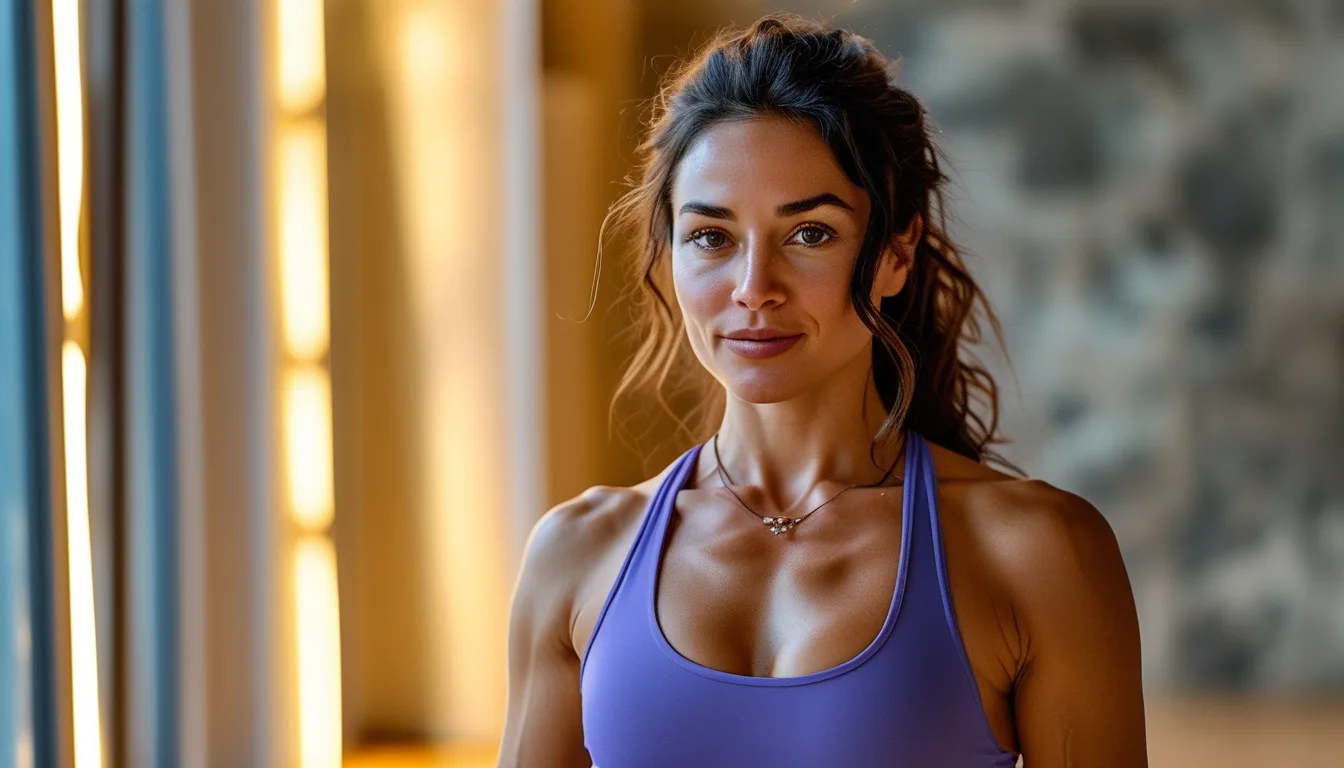
Seen here: Super High Waist Embossed Yoga Leggings with Inner Pocket — shop it on bubblelime.com
Keep Reading
This article is for general informational and styling purposes only. Fit, sizing, and product availability may vary.