Adult Gymnastics in a Cold Gym: What Actually Changes
Quick Answer: Gymnastics depends on range of motion, wrist and shoulder tolerance, and grip - all three of which are disproportionately affected by cold. A session in a 14C gym genuinely gives you less range and more joint discomfort than the same session at 22C. Extend the warm-up to 20 minutes, save flexibility work for the end, and accept that skill work in the first cold weeks will feel like regression it is not.
The injury risk is concentrated in wrists and shoulders, which are already the most-loaded joints in the sport.

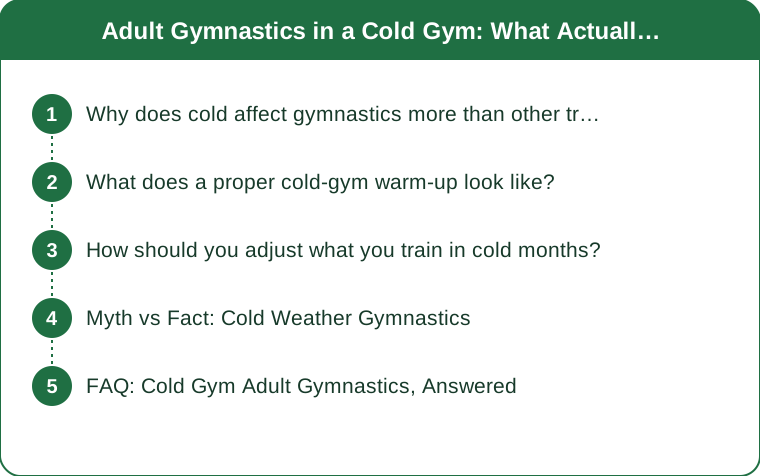
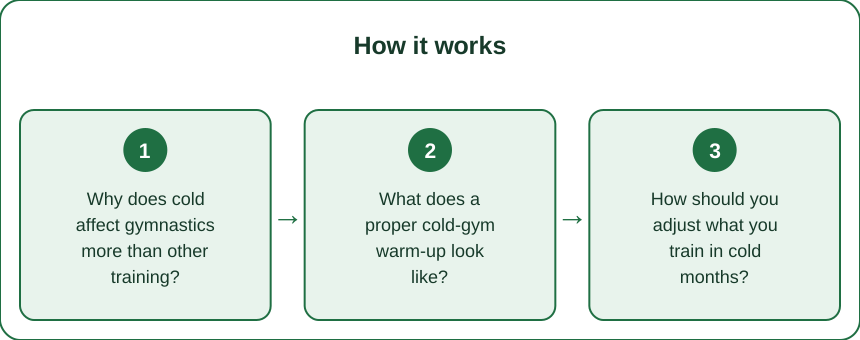
Why does cold affect gymnastics more than other training?
Because it targets range of motion and joint tolerance specifically, which is what gymnastics is made of.
Range of motion, which is the obvious one. Cold tissue is less compliant, and flexibility can be reduced by a meaningful margin in a cold gym. For a sport where a split, a bridge, or a shoulder position determines whether a skill is possible, that is the difference between doing it and not.
Joint tolerance, which is the more serious one:
- Synovial fluid is more viscous when cold, so joints move less freely
- Wrists are the most loaded joint in gymnastics and among the first to feel cold, being peripheral
- Shoulders similarly, and shoulder range in overhead positions is directly range-dependent
- Cold joints feel stiff and can be genuinely painful under load, and pushing through that is how injuries happen
Grip, which limits everything on bars:
- Hand strength declines measurably with hand temperature
- Cold hands are less sensitive, so you feel a grip slipping later
- Chalk works differently on cold dry hands - you may need less, not more
- Calluses crack in cold dry air, which is genuinely painful and stops training entirely
Power and reactivity:
- The stretch-shortening cycle is temperature-dependent, and tumbling and vaulting depend on it
- Reaction time slows, which affects landings and spotting
- Coordination is less precise, which matters more in gymnastics than almost any other sport
The fear factor, which is real for adult gymnasts. Feeling stiff and less capable increases hesitation, and hesitation in gymnastics is genuinely dangerous - a half-committed skill is more likely to go wrong than a fully committed one. Knowing that the stiffness is temperature is part of managing the fear.
What does a proper cold-gym warm-up look like?
About 20 minutes, structured, with flexibility work deliberately at the end rather than the beginning.
The structure:
- Minutes 1 to 6: general warming. Jogging, skipping, easy movement. Continue until you are genuinely warm - this is longer than it feels necessary
- Minutes 6 to 12: dynamic mobility. Leg swings, arm circles, thoracic rotations, cat-cow, gentle bridges. Moving through range, never holding
- Minutes 12 to 16: joint preparation, particularly wrists and shoulders. This is the part that prevents the most common injuries
- Minutes 16 to 20: progressive skill build, starting with the easiest versions and building
Wrist preparation specifically, which is non-negotiable in the cold:
- Wrist circles both directions, 15 each
- Kneeling wrist stretches, fingers forward then fingers back, gently, 20 seconds each
- Progressive weight-bearing - hands on a mat with light pressure, building to full weight over a minute
- Push-up position holds for 15 to 20 seconds before any handstand work
- Never go straight into handstands from cold. Wrist injuries in adult gymnastics are extremely common and almost always preventable
Shoulder preparation:
- Arm circles and cross-body swings
- Wall slides, 15 reps, which are the best single shoulder preparation drill
- Band pull-aparts and dislocates with a band or stick, moving progressively wider
- Hollow and arch holds, which prepare the shape and warm the trunk
Why flexibility work goes at the end:
- Static stretching on cold tissue is less effective and carries more risk
- It temporarily reduces power output, which you need for skill work
- The same stretch at the end of a session, on warm tissue, produces better results - so you lose nothing by moving it
Staying warm through a session:
- Layers you remove. Leg warmers and a long-sleeve top through the warm-up is standard practice for good reason
- Keep moving during waiting time. Adult classes involve queuing for apparatus, and standing still in a cold gym undoes the warm-up quickly
- Redo a short warm-up after any long wait - a minute of movement before you go again
- Keep hands warm between turns, in pockets or under sleeves
How should you adjust what you train in cold months?
Shift toward the things cold does not compromise, and treat winter as a strength block.
What to prioritise:
- Strength and conditioning, which is barely affected by cold once you are warm. Winter is an excellent block for the strength that makes spring skills possible
- Basic shapes and positions - hollow, arch, straddle - which are foundational and low-risk
- Drills and progressions rather than full skills
- Flexibility at the end of sessions, consistently, which is when it actually works
What to be cautious with in the first cold sessions:
- New skills, particularly inversions and anything with a landing
- Maximal flexibility work early in a session
- High-impact tumbling on cold tissue
- Anything you would hesitate on. A hesitant attempt is more dangerous than not attempting
The realistic expectation. Expect the first two or three cold sessions to feel like a step backwards. Range of motion and skill quality return as you adapt the warm-up - typically within a fortnight. Judging progress in the first cold week is a reliable way to feel unnecessarily discouraged.
Hand care through the season, which is genuinely limiting:
- File calluses down regularly rather than letting them build thick. Thick calluses crack in dry air, and a cracked callus costs a week of bar work
- Moisturise at night, not before training - moisturised hands before class reduce grip
- Chalk sparingly. In dry cold air, hands may already be too dry, and excess chalk makes it worse
- Consider grips if bar work is a substantial part of your training
Adult-specific considerations:
- Adults recover more slowly than the children the sport is built around, and cold adds to that
- Pre-existing joint issues are more symptomatic in the cold, which is worth accounting for rather than ignoring
- Adults have more fear, and cold-induced stiffness feeds it. Naming the cause helps
- Adult bodies are usually stiffer to start with, so the proportional effect of cold is larger
When to get something looked at: persistent joint pain rather than muscle soreness, pain that wakes you, numbness or tingling, or any pain that changes how you move. Wrist pain in particular should not be trained through - it becomes chronic readily. This is general information, not medical advice.
Myth vs Fact: Cold Weather Gymnastics
Myth: If you are stiff you should stretch harder to loosen up. Fact: Static stretching cold tissue is less effective and riskier. Warm the tissue with movement first - dynamic mobility raises temperature; static stretching does not. Save the deep stretching for the end.
Myth: Losing flexibility in winter means you lost your progress. Fact: Cold tissue is measurably less compliant, and range returns within minutes of proper warming. Your flexibility is intact; you cannot currently access it. Comparing a cold October session with a warm August one is not a fair comparison.
Myth: Wrist pain is just part of gymnastics. Fact: It is common, and it is not something to accept. Most wrist pain in adult gymnastics comes from insufficient preparation and progressive loading rather than from the sport itself. Persistent wrist pain should be assessed rather than trained through.
Myth: More chalk fixes cold grip problems. Fact: Often the opposite. Chalk absorbs moisture, and cold dry hands may already be too dry for good friction. Warming your hands is more effective than adding chalk, and excess chalk can make the grip worse.
Myth: Adults should train the same way children do. Fact: Adults recover more slowly, are typically stiffer, carry more pre-existing joint history, and have more fear. All four are amplified by cold. A longer warm-up and a more conservative progression is appropriate, not a concession.
FAQ: Cold Gym Adult Gymnastics, Answered
How long should I warm up in a cold gym?
About 20 minutes: six of general warming, six of dynamic mobility, four of wrist and shoulder preparation, and four of progressive skill building. That is roughly double a warm summer warm-up.
Why do my wrists hurt more in winter?
Wrists are peripheral, so they cool fastest, and they are the most loaded joint in gymnastics. Cold synovial fluid is more viscous and the joint moves less freely. Progressive weight-bearing preparation before any handstand work is essential.
Should I stretch before or after training in the cold?
After. Static stretching cold tissue is less effective, riskier, and temporarily reduces the power you need for skills. Dynamic mobility before, static stretching at the end on warm tissue.
Why has my flexibility gone backwards?
It has not - cold tissue is less compliant and the range returns once you are properly warm. Comparing a cold session to a warm one is not a fair test. Give it a fortnight of adjusted warm-ups.
What should I train when the gym is cold?
Strength and conditioning, basic shapes, and drills. Save new skills, maximal flexibility work, and high-impact tumbling for when you are fully warm or the gym is warmer. Winter is a good strength block.
How do I stop my calluses cracking?
File them down regularly rather than letting them build thick, and moisturise at night rather than before training. A cracked callus costs about a week of bar work, which is more than any single session is worth.
TL;DR:
- Cold targets exactly what gymnastics needs: range of motion, wrist and shoulder tolerance, and grip
- Warm up for 20 minutes, with dedicated wrist and shoulder preparation before any weight-bearing
- Put flexibility work at the end - cold static stretching is less effective and riskier
- Use cold months as a strength block; save new skills and inversions for when you are properly warm
- File calluses regularly and moisturise at night; a cracked callus costs a week of bar work
The first cold sessions feel like regression and are not. Give it a fortnight of longer warm-ups and the range comes back. Persistent joint pain, especially in the wrist, should be assessed rather than trained through - this is general information, not medical advice.
Keep Reading
This article is for general informational and styling purposes only. Fit, sizing, and product availability may vary.