What Two Weeks Off Actually Costs in Adult Gymnastics
Quick Answer: After two weeks off, strength is largely intact — measurable strength loss generally takes longer than that — but skill timing, grip conditioning and hand skin degrade quickly, and those are what make a return feel dramatic. Expect the first session back to feel disproportionately bad, expect it to normalise within two or three sessions, and do not test skills on day one. The most common injury pattern is doing week-four volume in session one.
You come back after a holiday and a skill you owned in July has vanished.
It has not. Here is what actually changed and what merely feels like it did.

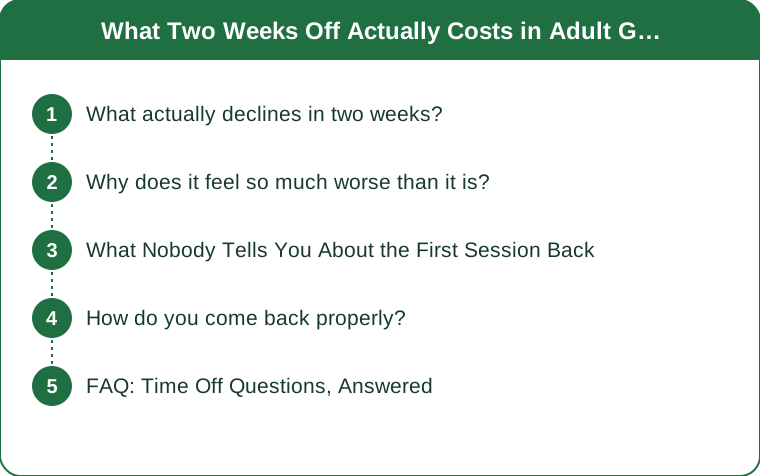
What actually declines in two weeks?
Less than it feels like, and in a specific order.
Strength is remarkably durable. Meaningful loss of maximal strength typically takes several weeks of complete inactivity, and short breaks of one to two weeks produce little measurable change in trained individuals. The strength you built is still there.
Neuromuscular coordination declines faster than strength. The timing, sequencing and precision of a skill are motor patterns, and they degrade more quickly than the muscle’s capacity to produce force. This is why you can still do the conditioning but the skill feels clumsy — a genuine dissociation, not your imagination.
Hand skin is the fastest thing to change. Calluses soften within days without regular bar contact. Coming back to a full bar session on soft hands is the single most reliable way to tear, and a rip costs you another week. This is the most underrated cost of a break.
Grip endurance drops noticeably. Forearm endurance is trained by frequent hanging and gripping, and it detrains faster than gross strength. Many people find their hands give out long before their shoulders on the first session back.
Flexibility declines meaningfully. Range of motion regresses faster than strength, particularly for actively maintained ranges. Splits and shoulder flexibility feel notably worse after two weeks, and this is normal and comes back quickly.
Body awareness in the air degrades. Anything inverted or rotational relies on a spatial sense that is maintained by practice. It comes back within a couple of sessions and it feels alarming while it is missing.
And confidence drops disproportionately, which is the factor that matters most in practice. Fear of inverting or committing to a skill returns much faster than the physical capacity is lost, and it is the real reason the first session back feels so poor.
Why does it feel so much worse than it is?
Because the things that degrade fastest are the things you notice most.
Skill quality is highly visible. A handstand that used to hold for twenty seconds now wobbles at eight, and that is immediately obvious in a way that a two percent change in strength never would be.
Sensation is not a measure of capacity. Everything feels heavier after a break — partly from reduced neural drive, partly from lost familiarity, and partly because you are comparing to your best day rather than your average one.
You lost the accumulated warm-up effect. Regular training keeps joints, tendons and tissue accustomed to specific ranges and loads. That readiness fades within days, so the first session back loads tissue that has become unfamiliar with it.
Soreness comes back hard. The repeated bout effect — the protection against muscle soreness that regular training provides — fades measurably over a couple of weeks. Doing your normal session after a break produces disproportionate soreness, which then feels like evidence of lost fitness when it is simply the loss of that protection.
You compare to your peak, not your baseline. Most people remember their best session before the break, which was not their typical session. The gap between that memory and the first day back is much larger than the gap in actual capacity.
And the psychological weight is real. Fear of skills, particularly inverted ones, is a well-documented feature of returning to gymnastics as an adult. It resolves with graded exposure rather than with willpower.

What Nobody Tells You About the First Session Back
The injuries and setbacks happen in the first session, not during the break, and they happen for predictable reasons.
The most common mistake is doing your normal volume. You feel fine in the warm-up, your strength is genuinely intact, so you run the session you always run. Tissue tolerance has dropped even though strength has not, and that mismatch is where strains happen.
Hands are the second most common casualty. Soft calluses plus a normal bar volume equals a rip, and a rip means another week off bars — turning a two-week break into a four-week one. Half your normal bar volume in the first session, and moisturise the days before you return rather than the day after you tear.
Wrists take a disproportionate hit. Weight-bearing on the hands is a specific tolerance that degrades quickly. Handstand and floor volume should be reduced more aggressively than you expect, and wrist prep in the warm-up matters more on a return than at any other time.
Do not test skills on day one. The overwhelming instinct is to find out whether you still have it. Testing a skill with degraded timing, degraded body awareness and degraded confidence is exactly the wrong combination. Give it two sessions of basics first, then test.
Expect the second session to feel worse than the first, because that is when the soreness lands. This is normal and it is not a sign of anything wrong.
Regain conditioning before skills. Two sessions of shapes, holds, drills and basics does more for your skills than one session of attempting them, because it restores the substrate the skills are built on.
And schedule the return deliberately. Coming back on a day when you are rested, rather than squeezing it into a busy week, changes the outcome of that first session substantially.
How do you come back properly?
A three-session ramp, and then you are back to normal.
Session one: half volume, no skill testing. Full warm-up with extra wrist and shoulder preparation. Conditioning, shapes, basic drills. Bar work limited to a fraction of your normal volume purely to reintroduce the hands. Leave feeling like you could have done more — that is the target, not a compromise.
Session two: about three-quarters volume. Reintroduce familiar skills you are confident in. Still avoid anything you were working at the edge of your ability before the break. Expect soreness from session one to be present, and work through it at reduced intensity rather than skipping.
Session three: close to normal. Most people are essentially back by here. Now is the point to test the skill you were worried about, with a coach and appropriate matting.
Prioritise flexibility work during the break itself. Range of motion is what declines most and it is also the easiest thing to maintain away from a gym. Ten minutes a day of active flexibility during two weeks off substantially reduces what you have to rebuild.
Do some hanging if you can. Even a doorway bar or a park bar for a couple of minutes a few times a week keeps grip endurance and hand skin from softening entirely. This is the single most efficient thing you can do to protect your return.
Keep basic conditioning going if it is easy. Hollow holds, arch holds, push-ups and core work require nothing and preserve the shapes that everything is built on.
Be realistic about longer breaks. Two weeks is a blip. Six weeks or more is a genuine detraining period where strength does decline, and the ramp should be proportionally longer — think four to six sessions rather than three.
Seasonally, this is worth planning for now. Late summer holidays, then the run-up to the end of the year, produce the two biggest gaps in most adult gymnasts’ training years. Knowing in advance that a break is coming lets you keep flexibility and hanging going through it, which turns a rough return into an easy one.
If you return with pain rather than soreness — particularly joint pain, or anything sharp — that needs assessment rather than a training adjustment. This is general information, not medical advice.
FAQ: Time Off Questions, Answered
How much strength do I actually lose in two weeks?
Very little. Research on short-term detraining in trained individuals consistently shows minimal loss of maximal strength over one to two weeks. What you lose is coordination, conditioning and tissue tolerance.
Why do my hands rip on the first session back?
Calluses soften within days without bar contact. Half your normal bar volume for the first two sessions is the fix, and it is more effective than any hand care product.
Should I train through the soreness in session two?
Usually yes, at reduced intensity — movement generally helps delayed soreness. Sharp or joint pain is different and is a reason to stop.
Will I lose my skills entirely?
No. Motor patterns are durable over this timescale; what degrades is the precision and confidence of executing them. Most adults find familiar skills return within two or three sessions.
Is it worth training during a holiday?
A few minutes of flexibility and some hanging if a bar is available is disproportionately valuable. A full session is not necessary and a complete rest is genuinely fine for two weeks.
What if I keep taking two-week breaks?
Repeated short breaks are far less damaging than people fear, provided each return is ramped properly. The pattern that causes problems is the break followed by a full-volume return, repeated — that is how overuse injuries accumulate.
TL;DR:
- Two weeks off costs you almost no strength. It costs coordination, flexibility, grip endurance and hand skin.
- The first session feels bad because of lost tissue tolerance and confidence, not lost capacity.
- Do not test skills on day one. Two sessions of basics first, then test with a coach.
- Half your bar volume for the first two sessions or you will rip, turning two weeks off into four.
- Ten minutes a day of flexibility and a few minutes of hanging during the break removes most of the cost.
Expect session two to feel worse than session one. That is the soreness landing, not a problem.
Keep Reading
This article is for general informational and styling purposes only. Fit, sizing, and product availability may vary.