Why Adult Gymnastics Progress Stalls Hard After a Fast Beginner Start
Quick Answer: The fast progress in your first 2-3 months of adult gymnastics comes from neurological adaptation — your brain learning new movement patterns quickly. Once that phase ends, further progress depends on actual strength and flexibility gains, which build far slower. The plateau isn’t a sign you’ve stopped improving; it’s a sign the easy gains are used up.
Your first two months of adult gymnastics felt like a highlight reel — new skills every week, visible progress every class. Then it stopped, seemingly overnight. Here’s what actually changed.

Why is early progress in gymnastics so fast?
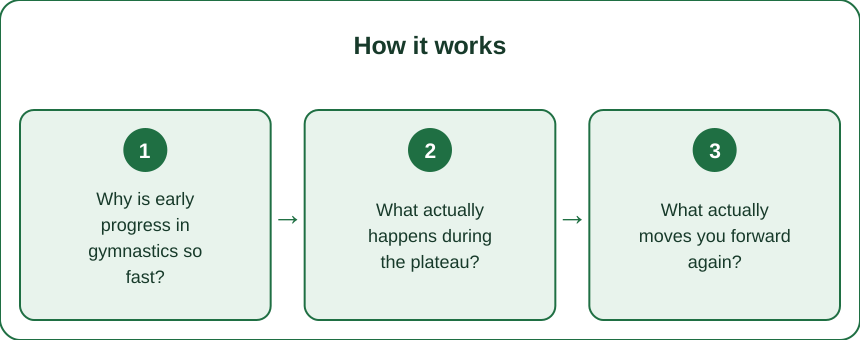
The first phase of learning any new skill is dominated by neurological adaptation — your nervous system learning to recruit the right muscles in the right sequence for a movement it’s never attempted before. This kind of learning is genuinely fast; measurable improvements can happen session to session.
But neurological adaptation has a ceiling. Once your body knows how to attempt a cartwheel or handstand, further progress requires the muscles and connective tissue involved to actually get stronger and more flexible — and that process is dramatically slower, typically measured in months, not weeks.
What actually happens during the plateau?
You’re not failing to progress — you’re building the physical capacity (strength, flexibility, tissue resilience) that the next skill actually requires, and that process is invisible session-to-session. A handstand hold that gains 2 seconds over 6 weeks feels like nothing compared to learning an entirely new skill in week 1, but it represents real physiological adaptation happening at the only rate it can happen.

What actually moves you forward again?
Targeted conditioning outside of skill practice — specific strength work (hollow holds, handstand-specific shoulder strength, wrist conditioning) done 2-3x a week separate from your regular class, addresses the underlying capacity gap that class time alone often doesn’t have room for.
Most adult gymnasts who push through a plateau do so by adding 10-15 minutes of targeted conditioning rather than more repetitions of the stuck skill itself.
What Nobody Tells You About the Adult Gymnastics Plateau
Here’s the part most classes don’t say out loud: the plateau is actually a sign the beginner phase worked correctly. If you never hit a slowdown, it usually means you stopped attempting harder skills, not that you found some hack to keep the fast-progress phase going indefinitely.
Adult gymnasts who’ve been training 2+ years consistently describe the same pattern: fast start, hard plateau around month 2-3, then a slower but steady climb punctuated by occasional breakthroughs — not a repeat of that first easy phase.
FAQ: Adult Gymnastics Plateau Questions, Answered
How long does the typical plateau last?
Most people report 6-10 weeks of feeling stuck before a breakthrough, assuming consistent practice and some targeted conditioning added in.
Should I take a break if I feel stuck?
A short break (1 week) can help mentally, but stepping away for a month risks losing some of the physical adaptation you’ve built — consistency, even at a slower pace, tends to work better than stopping.
Is it normal to feel frustrated compared to how fast I improved at first?
Completely normal, and close to universal among adult gymnasts — the comparison to your own fast start is the trap, not a sign something’s wrong with your training.
TL;DR:
- Fast early gains come from neurological learning, which has a ceiling within 2-3 months
- The plateau after that reflects the slower pace of real strength and flexibility adaptation
- Adding 10-15 minutes of targeted conditioning outside class often breaks the stall
- A hard plateau after a fast start is normal and expected, not a sign of failure
Keep Reading
This article is for general informational and styling purposes only. Fit, sizing, and product availability may vary.