Why Adults Should Learn to Fall Before Learning Anything Else
Quick Answer: Adults arrive at gymnastics without the fall reflexes children build through constant practice, and the instinctive adult response - stiffening and reaching out a straight arm - is precisely what causes wrist and shoulder injuries. Learning to roll, to tuck the chin, and to spread impact across a large surface takes a few sessions and removes most of the risk.
It also removes most of the fear, which is what actually limits adult progress.
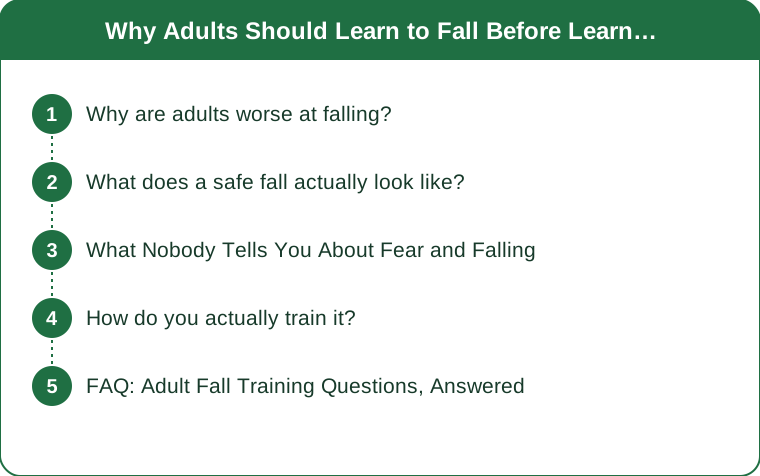
Why are adults worse at falling?
Not because of age or fragility, primarily. Because of practice - or the lack of it.
Children fall many times a day for years. Every one of those falls is a repetition, and the nervous system builds automatic protective responses from repetition like any other motor skill. By the time a child reaches a gymnastics class, they have an enormous amount of unstructured falling practice behind them.
Adults, by contrast, may go years without falling at all. The responses were built in childhood and have since decayed from disuse. What remains is a cruder, slower version.
The specific adult failure mode is well recognized: stiffening and reaching out with a straight arm. It is an entirely sensible-looking reflex - stop yourself hitting the ground - and it concentrates the entire force of the fall into one wrist, one elbow, and one shoulder, with the arm locked so nothing absorbs the load. That is the mechanism behind most fall-related upper limb injuries.
Three other adult-specific factors:
- More mass. A bigger body falling the same distance carries more energy, and impact forces scale accordingly.
- Stiffer tissue. Adult connective tissue and joints have less give, so more of the impact is transmitted rather than absorbed.
- More fear. Fear causes tensing, and tensing prevents the yielding that a safe fall requires. The fear is rational and it makes the outcome worse - which is the cruel part.
The encouraging half: falling is a trainable skill, and it trains quickly. Adults who spend a few sessions on it develop usable responses within weeks, because the underlying capacity is there and simply needs re-activation.
What does a safe fall actually look like?
Four principles that apply to nearly every fall, regardless of direction.
1. Spread the impact over the largest possible area. Force concentrated on a small area is what breaks things. The same energy distributed across a forearm, upper arm, and back is far more survivable than the same energy through one palm. This is the principle behind every technique below.
2. Convert linear motion into rotation. A roll converts downward energy into rotational motion, dissipating it over time and distance rather than all at once. This is the entire logic of a gymnastics roll and it is why martial arts and gymnastics both teach it first.
3. Tuck the chin. In any backward fall, the head is the priority. Chin to chest keeps the back of the head off the floor. This should become reflexive, and it is trainable independent of everything else.
4. Do not reach with a straight arm. The hardest habit to unlearn, and the most important. Bent arms can absorb; straight arms transmit. If a hand does go down, the elbow should be soft.
The main techniques worth learning, in order:
- Backward roll from a seated position. Start on the floor, so there is no height and no fear. Round the back, tuck the chin, roll along the spine. Get comfortable here before adding anything.
- Backward fall from a squat. From a low squat, sit back, round the spine, chin tucked, and let the back roll along the mat. Arms slap the mat at a 45-degree angle to add a braking surface - never behind you and never straight.
- Side fall. Land along the side of the body, from hip to shoulder, with the arm slapping the mat to spread force. Chin tucked toward the opposite shoulder.
- Forward roll over the shoulder. Not over the head - over one shoulder, diagonally across the back. This is the version that works from height and from motion, and it is the most useful single technique.
Progress each from the floor, then from a low squat, then from standing, then from movement. Never skip the floor stage because it seems too easy - that is where the pattern is built.

What Nobody Tells You About Fear and Falling
The fear is not irrational and telling yourself to relax does not work. But fear responds to competence, and that is the lever.
Adults are commonly told their fear of falling is the obstacle - be braver, commit more. That framing is unhelpful, because the fear is a reasonable assessment of a real situation by someone who has no trained response. Fear of something you genuinely cannot handle safely is accurate.
Which points at the actual solution. Fear reduces when capability increases, not when you decide to feel differently. An adult who knows how to fall from height onto a mat has less fear of the skill above it, not through willpower but because the assessment has changed.
How this plays out in practice:
- A gymnast learning a back handspring is not primarily learning to be brave. They are learning that a failed attempt has a known, practiced outcome. Once bailing is a skill, attempting is a much smaller decision.
- Fear that persists after competence is built is usually about something specific rather than the skill in general - a previous injury, a bad experience, or a particular position. Naming the specific thing makes it addressable.
- Tension caused by fear increases injury risk, so fear is self-fulfilling until it is broken by training. This is the loop that stalls adult beginners.
What helps concretely:
- Train the bail before the skill. For any new inversion, learn the exit first. This is standard coaching practice and it changes progression dramatically.
- Use progressions that are genuinely safe, not ones that merely feel safe. Mats, spotters, and low heights are not signs of timidity; they are how skills get built.
- Accept the plateau. Fear returns with each new height and each new skill, and it clears the same way each time. It is not a sign that you are not cut out for this.
The thing worth internalizing: the confident adults in the gym are not braver than you. They have fallen more, on purpose, on mats.
How do you actually train it?
Ten minutes at the start of a session, consistently, for a few weeks.
Weeks one and two - floor level, no height:
- Seated backward rolls, 10 repetitions
- Rocking on a rounded back with chin tucked, 20 repetitions - builds the spinal rounding pattern
- Side falls from lying, then from sitting, 5 each side
- Shoulder rolls from kneeling, 5 each side
Weeks three and four - low height and motion:
- Backward fall from a squat, 10
- Side fall from a low squat, 5 each side
- Shoulder roll from a crouch, then walking, 5 each side
- Practice the slap: arm at 45 degrees, palm down, contacting at the same moment as the body
Ongoing:
- Roll from standing and from a small jump
- Roll in the direction of travel from a light run
- Deliberately practice falling in unexpected directions, at low speed, so the response generalizes
Rules throughout:
- Mats, always, and enough of them
- Never train falling when fatigued. Poor technique gets grooved when tired, and tired falling is how people get hurt practicing not getting hurt.
- Progress one variable at a time - height, or speed, or direction, never two together
- Have a coach watch early. Learning falling wrong is worse than not learning it, and a few minutes of feedback prevents that
What carries over beyond the gym is substantial: fall technique transfers to icy pavements, trail running, cycling, and everyday trips - one of the few gym skills with direct life application. Learning to roll rather than reaching out is a genuinely durable investment.
If you have a wrist, shoulder, neck, or back condition, or a history of head injury, speak to a coach and a clinician before starting fall training. Some techniques need modification and some should be avoided. This is general information, not medical advice.
FAQ: Adult Fall Training Questions, Answered
Am I too old to learn this?
No. Fall technique is a motor skill and motor skills remain learnable throughout life. Progression may be slower than a child’s and joints may need more warm-up and more recovery, but adults learn these patterns reliably. Start lower and progress slower than a teenager would, and expect it to work.
What if I have a wrist injury already?
More reason to learn, since the whole point is to stop landing on wrists - but get clearance and coaching first, since some of the drills load the wrist during setup. A coach can modify the progressions. Fall training with an existing injury should be supervised rather than self-taught.
Should I practice at home?
Only the floor-level work, and only on adequate padding - a carpeted floor is not enough for rolls. Backward rolls in particular carry a neck risk if done wrong, and they are worth learning under supervision first. Once a coach has confirmed your technique, gentle repetition at home on a mat is reasonable.
How long until it becomes automatic?
Basic patterns feel comfortable within a few weeks of consistent practice. Genuine automaticity - responding correctly to an unexpected fall without thinking - takes months and requires practicing in varied and unpredictable conditions. Most people notice the fear reduction well before the reflex is fully automatic, which is itself a good reason to start.
TL;DR:
- Adults fall badly because they are out of practice, not because they are fragile - the reflex to reach with a straight arm is what causes most injuries.
- Four principles: spread the impact, convert falling into rolling, tuck the chin, never straighten the arm.
- Learn seated rolls, backward falls from a squat, side falls, and the shoulder roll - in that order, from the floor upward.
- Fear drops when capability rises, not through willpower - train the bail before the skill.
- Ten minutes at the start of a session for a few weeks is enough to build usable responses.
The confident adults in the gym are not braver. They have fallen more, deliberately, onto mats. This is general information, not medical advice.
Keep Reading
This article is for general informational and styling purposes only. Fit, sizing, and product availability may vary.