How Long to Actually Wait Before Returning to Adult Gymnastics After a Wrist or Ankle Tweak
Quick Answer: A minor wrist or ankle tweak in adult gymnastics typically needs 1-2 weeks of reduced load before returning to weight-bearing skills, and a genuine sprain needs 3-6 weeks with a gradual reintroduction — returning based on pain-free range of motion at rest, rather than just “it doesn’t hurt today,” is the more reliable marker.
Adult gymnastics puts unusually high repetitive load through wrists and ankles compared to most recreational fitness activities, which makes the return timeline more consequential to get right than in many other sports.

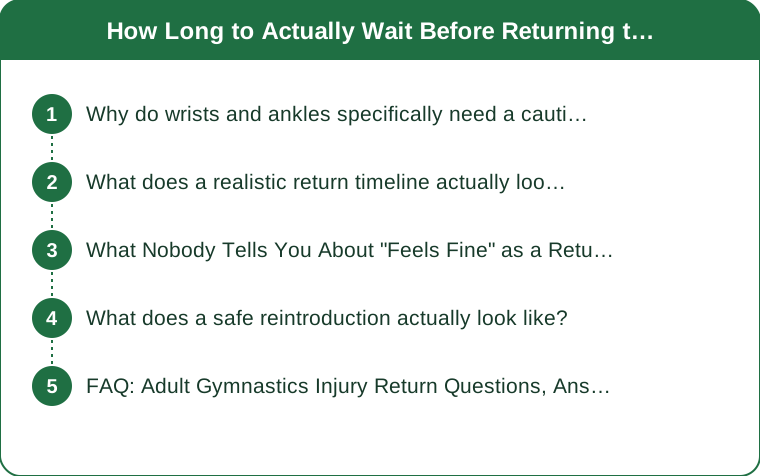
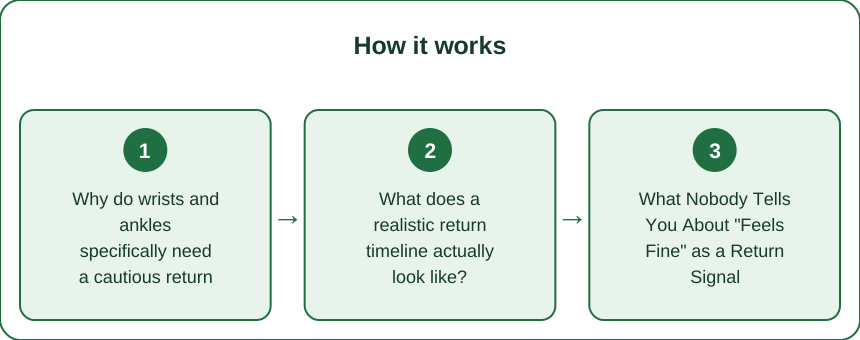
Why do wrists and ankles specifically need a cautious return in gymnastics?
Gymnastics skills — handstands, cartwheels, tumbling, landings — place repeated, high-impact load directly through the wrist and ankle joints, unlike most gym or cardio activities where these joints see comparatively gentle, low-impact use. A wrist or ankle that feels fine during daily activities can still be under-recovered for the specific high-load demand gymnastics skills place on it, which is why the “if it doesn’t hurt, I’m fine” heuristic underperforms for this sport specifically.
What does a realistic return timeline actually look like?
- Minor tweak, no real sprain (mild discomfort, no swelling): 1-2 weeks of avoiding weight-bearing skills on that joint, replaced with non-loading conditioning work
- Mild sprain (some swelling, discomfort with weight-bearing): 3-4 weeks, typically starting with pain-free range of motion work before any loading
- Moderate sprain (notable swelling, pain limiting normal walking or hand use): 4-6+ weeks, generally warranting a medical evaluation before returning to any gymnastics-specific loading
- Any injury with persistent swelling, instability, or pain beyond the expected timeline: worth a doctor or physical therapist evaluation rather than continuing to self-manage the timeline

What Nobody Tells You About “Feels Fine” as a Return Signal
Here’s the trap that catches a lot of returning adult gymnasts: a joint can feel completely normal during daily activities and still not be ready for the specific compressive, high-impact load of a handstand or landing. Walking, typing, and light gripping use a fraction of the force a wrist absorbs landing from even a modest vault or supporting body weight in a handstand — feeling fine in daily life is a low bar that doesn’t confirm readiness for gymnastics-specific loading.
A better readiness check is testing controlled, low-impact versions of the actual movement pattern (a wall-supported partial handstand hold, for instance) before returning to full unsupported skills, rather than jumping straight back to full training intensity.
What does a safe reintroduction actually look like?
- Week 1 of return: Pain-free range of motion and light conditioning, no weight-bearing on the injured joint
- Week 2-3: Supported or partial loading (wall-supported handstand holds, assisted landings) at low volume
- Week 3-4+: Gradual return to full skills, starting with lower-difficulty versions before progressing back to pre-injury level
- Throughout: Any recurrence of pain or swelling at a given stage is a signal to step back to the previous stage, not push through
FAQ: Adult Gymnastics Injury Return Questions, Answered
Is it safe to cross-train other body parts while a wrist or ankle recovers?
Generally yes — training unaffected areas (core, legs if it’s a wrist injury, or upper body if it’s an ankle) maintains overall fitness without loading the recovering joint, as long as it doesn’t require gripping or weight-bearing on the injured side.
Should I tape or brace the joint when returning?
A brace or tape can provide helpful proprioceptive feedback and mild support during the reintroduction phase, though it’s not a substitute for adequate healing time or proper progression.
When does a wrist or ankle tweak actually need a doctor’s evaluation rather than self-managed rest?
Persistent swelling beyond a week, visible deformity, inability to bear any weight or grip, or pain that doesn’t improve with rest are all signals to get a professional evaluation rather than guessing at a home timeline.
TL;DR:
- Minor tweaks need 1-2 weeks off loading; genuine sprains need 3-6+ weeks with gradual reintroduction
- “Feels fine in daily life” is a low bar that doesn’t confirm readiness for gymnastics-specific impact loading
- Test controlled, supported versions of the actual skill before returning to full unsupported training
- Persistent swelling, instability, or pain beyond the expected timeline warrants a professional evaluation, not more guessing
This is general information, not medical advice — recurring or severe wrist and ankle issues deserve a sports medicine evaluation rather than a self-managed timeline.
Keep Reading
This article is for general informational and styling purposes only. Fit, sizing, and product availability may vary.