Adult Gymnastics: How to Split Conditioning and Skill Time
Quick Answer: For most adults, roughly 40 to 50 percent of training time should be conditioning and 50 to 60 percent skill work, and the conditioning should come mostly outside class rather than eating into gym time. The single biggest reason adult progress stalls is a strength deficit — children learn skills first and build strength through them, while adults have to build the strength first because the skills expose it immediately.
The uncomfortable version: if you cannot hold a hollow body for 45 seconds, more handstand attempts will not produce a handstand.
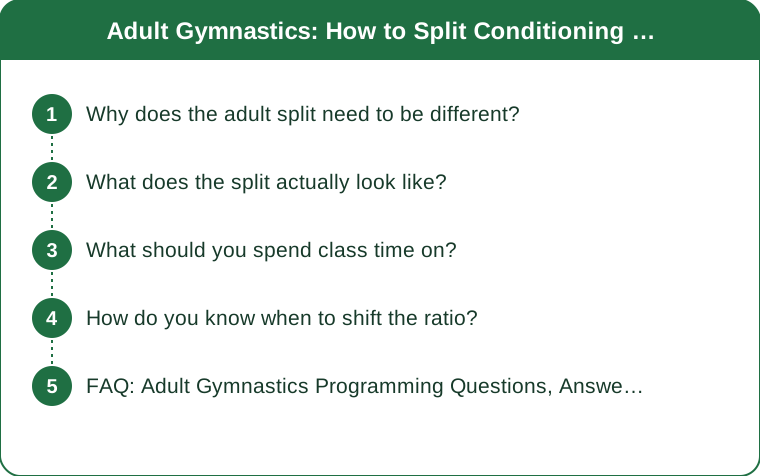
Why does the adult split need to be different?
Because adults and children arrive with opposite profiles.
Children have a strength-to-weight advantage. Lower absolute body mass, shorter levers, and years of daily unstructured movement. A child can attempt a skill repeatedly and build the required strength through the attempts, because the attempts are within their capacity.
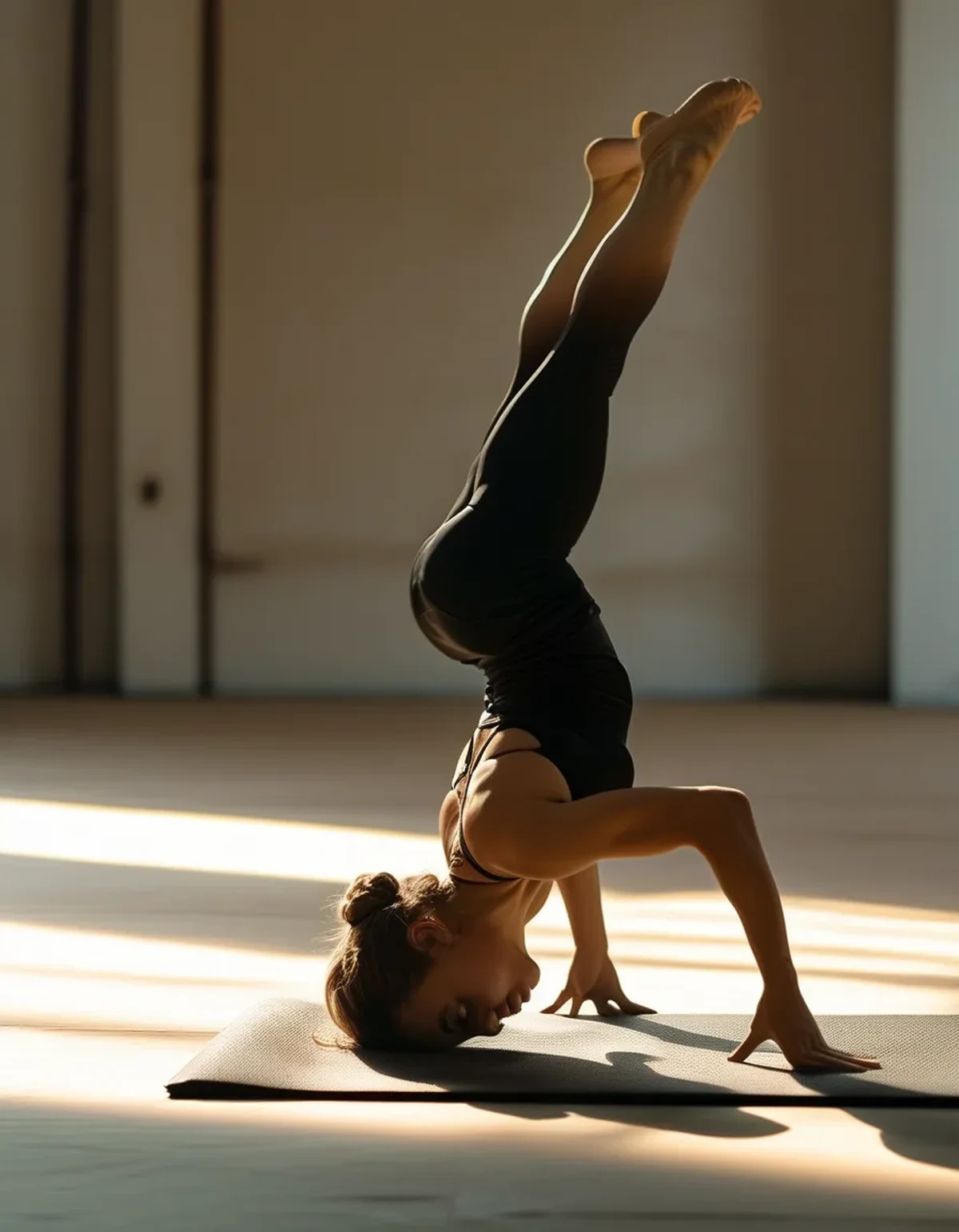
Adults have length and mass working against them. Longer limbs mean longer lever arms, which means substantially more torque required to hold the same position. An adult attempting a handstand without the requisite shoulder and core strength is not practicing a handstand — they are failing at a strength test repeatedly.
Adults also have specific deficits from sitting. Limited shoulder flexion, restricted thoracic extension, tight hip flexors, and weak deep core. These are the exact qualities gymnastics demands most, and they do not improve from skill attempts alone.
And adults have less training time. A young gymnast might train 12 hours a week; an adult recreational gymnast gets two to four. That scarcity is what makes people want to spend it all on skills — and it is exactly why the allocation has to be deliberate.
The reframe: conditioning is not the tax you pay to do gymnastics. For adults it is the mechanism through which skills become available.
What does the split actually look like?
Split the week, not just the session.
In class — 20 to 30 percent conditioning, 70 to 80 percent skill. Class time is expensive, coached and has equipment you do not have at home. Use it for the things that require those: apparatus, spotting, feedback, drills. Do the general strength work elsewhere.
Outside class — two 20 to 30 minute conditioning sessions a week. This is where the actual strength work lives, and it needs no gymnastics equipment.
Net weekly allocation ends up around 40 to 50 percent conditioning, which is what most adult programs converge on.
What that home conditioning contains:
- Hollow body and arch holds — the foundational shapes for everything. Build to 45 to 60 seconds.
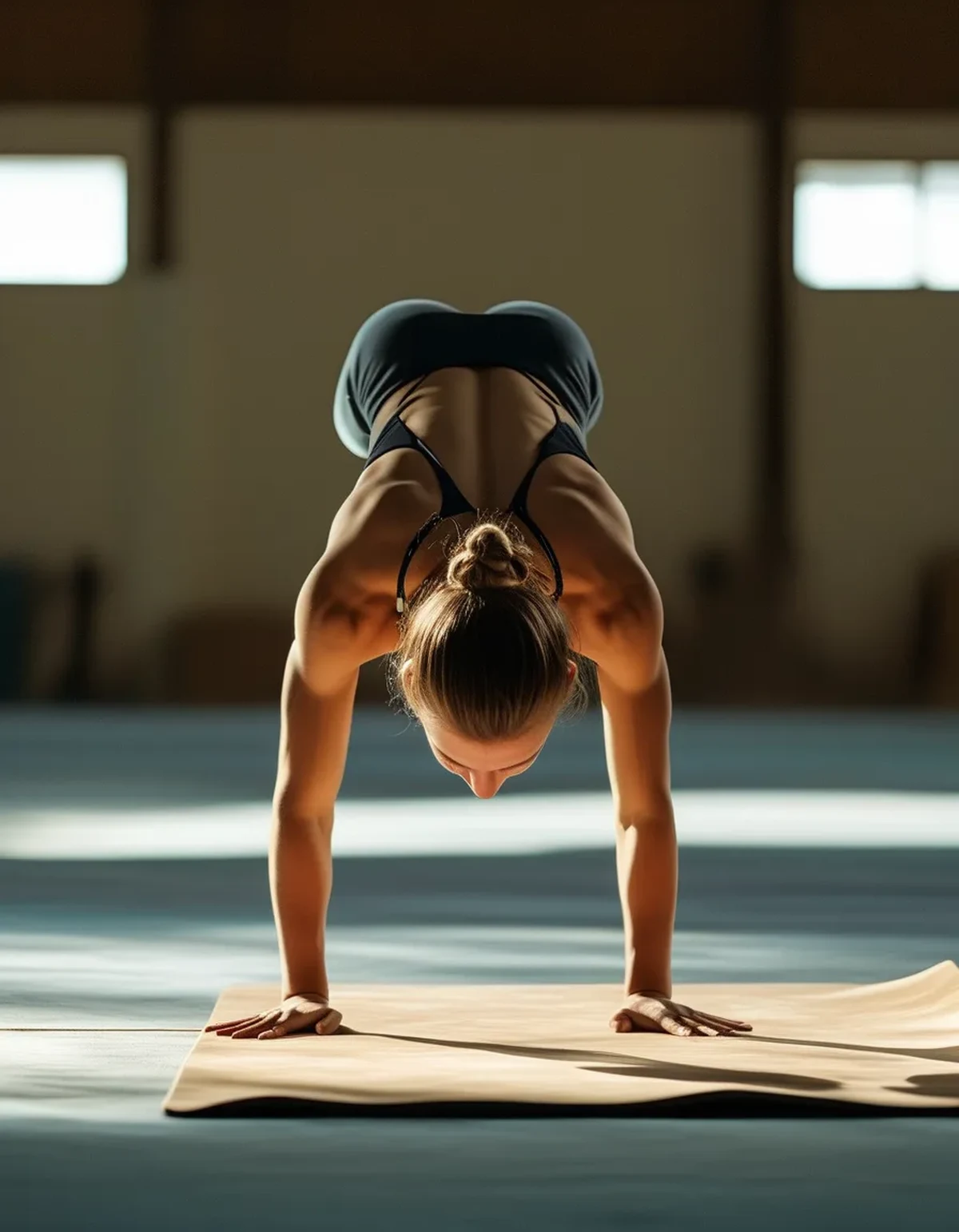
- Wall handstand holds — chest-to-wall, building toward 60 seconds
- Straight-arm strength — planche leans, ring or bar support holds
- Pulling — rows and pull-up progressions
- Shoulder flexion mobility — daily, in small doses, not once a week in a long session
- Wrist preparation — non-negotiable, and the single most-skipped item
Sets and reps: 3 to 4 sets of each, working close to but not at failure, two sessions a week. This is not a lot of volume and it is enough to change what is possible in class within eight to twelve weeks.
What should you spend class time on?
The things that only exist in that room.
Apparatus. Bars, beam, vault, rings. You cannot replicate these at home and every minute on them is high value.
Anything requiring a spot. Inversions, back handsprings, anything where the failure mode matters. This is what a coach is for, and it is not replaceable by a video.
Feedback on shapes. Your hollow body is probably not what you think it is. Ten seconds of correction from a coach is worth more than an hour of unsupervised practice reinforcing the wrong shape.
Drills on equipment you lack. Mats, pits, blocks, panel mats and springboards let you break skills into pieces that are impossible to isolate at home.
What to stop spending class time on: general conditioning circuits you could do in your living room, long stretching sessions, and repeated attempts at a skill you are not yet strong enough to perform. That last one is the hardest to give up and the most valuable to give up.
A useful test before attempting a skill: can you hold the component positions statically? A cartwheel needs a momentary handstand; a pullover needs a pulling capacity. If the static version is not there, the dynamic version is a lottery ticket, not practice.
How do you know when to shift the ratio?
Four signals that the balance is wrong in one direction or the other.
Signs you need more conditioning:
- You attempt a skill and your arms bend or your body sags — that is strength, not technique
- You can do a skill occasionally but not reliably
- You fatigue within the first third of class
- Your shapes deteriorate visibly after 20 minutes
Signs you need more skill time:
- You are comfortably strong in the component positions but the skill is not assembling
- Your conditioning numbers have improved for months with no skill change
- You feel hesitant or timid rather than weak — that is a practice and confidence problem, and more strength does not fix it
Signs you need more mobility, not either:
- Your handstand has a banana shape you cannot correct even when fresh
- You cannot reach overhead without arching your lower back
- You are strong in the position but cannot get into it
A reasonable review cycle: reassess every eight weeks. Test the same benchmarks — hollow hold time, wall handstand time, pull-up count, shoulder flexion against a wall — and look at what moved. If nothing moved in eight weeks, the allocation or the intensity needs changing, not the exercises.
And on wrists specifically: wrist discomfort is the most common reason adults stop, and it is largely preventable with consistent preparation and gradual load progression. Persistent wrist pain warrants a proper assessment rather than pushing through. This is general information, not medical advice.
FAQ: Adult Gymnastics Programming Questions, Answered
Can I lift weights alongside gymnastics?
Yes, and it helps — general pulling and pressing strength transfers well. Keep heavy lower body work away from the day before a skills class, since fresh legs matter for tumbling and vault. Two lifting sessions plus one or two gymnastics sessions a week is a workable structure for most adults.
How long before I see skills come together?
For someone starting with limited strength, expect three to six months of consistent conditioning before the basics — cartwheel, handstand hold, pullover — start becoming reliable. People coming from a dance, climbing or lifting background often move faster.
Should I stretch before or after class?
Dynamic mobility and joint preparation before, longer static work after or on separate days. Extended static stretching immediately before skills work can reduce the stiffness you rely on for tumbling.
Is once a week enough?
One class a week plus two home conditioning sessions produces real progress. One class a week and nothing else generally does not, which is precisely the split problem this whole article is about.
TL;DR:
- Aim for roughly 40 to 50 percent conditioning across the week, but keep class time 70 to 80 percent skill.
- Do general strength at home in two 20 to 30 minute sessions; save the gym for apparatus, spotting and feedback.
- Adults need strength before skills because longer levers make the same shape far harder.
- Hollow holds, wall handstands, straight-arm work, pulling, shoulder mobility and wrist prep are the core six.
- Reassess benchmarks every eight weeks and shift the ratio based on what actually moved.
The skills are not being withheld by technique. For most adults they are waiting on a strength threshold, and the fastest route to them is the least glamorous one.
Keep Reading
This article is for general informational and styling purposes only. Fit, sizing, and product availability may vary.